





 +41 22 880 28 88
 +33 1 41 69 88 88 (Paris)
 +352 26 20 25 53 88
 +971 55 303 5161
 +66 92 372 4680

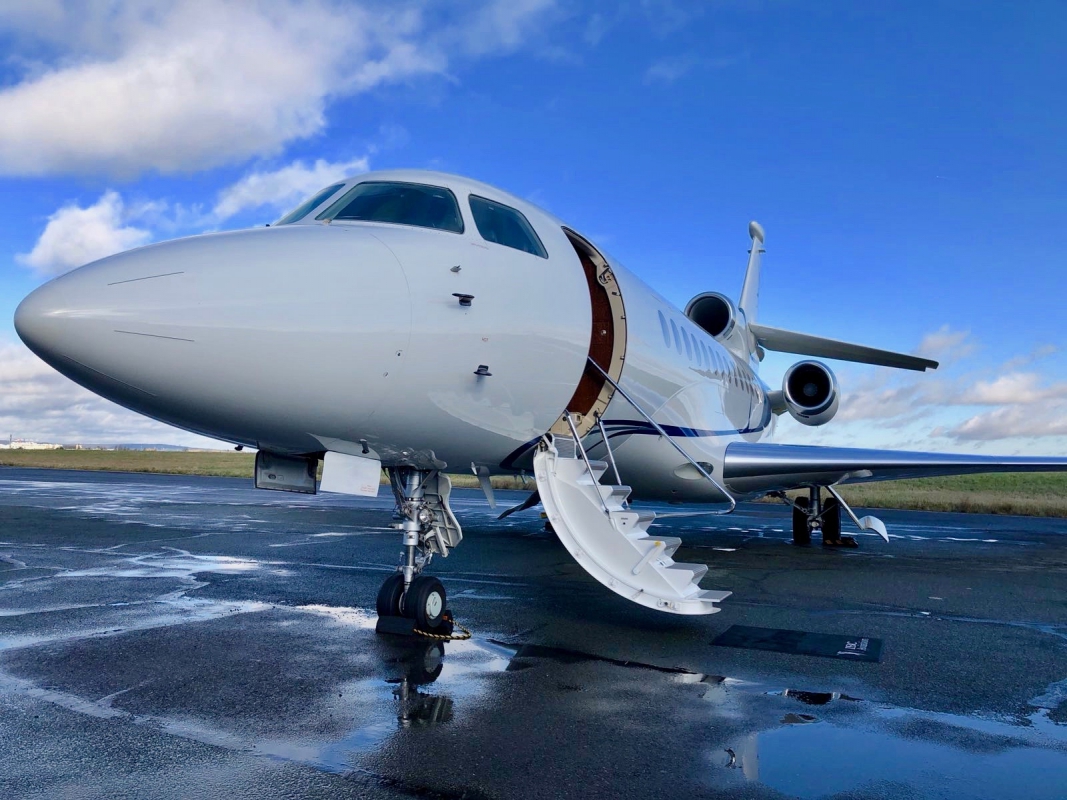
Heavy Jet or Ultra Long Range: Which Category to Choose
Heavy jet or ultra long range: the comparison at a glance
The two categories look alike inside the cabin and part company on range. Here are the figures that actually decide.
| Criterion | Heavy jet | Ultra long range |
| Range | 6,000 to 8,500 km | 8,500 to 14,000 km |
| Flight duration | 6 to 8 hours | 10 to 16 hours |
| Passengers | 8 to 13 | 12 to 19 |
| Cabin height | 1.80 to 1.90 m | 1.85 to 1.95 m |
| Cabin zones | 2 distinct areas | 3 to 4 distinct areas |
| Typical sector | Paris to or from New York | Paris to or from Singapore |
Range, the only criterion that truly decides
A heavy jet connects Paris to or from New York, Geneva to or from Dubai, or London to or from Jeddah without stopping. Those three sectors cover most transatlantic and Middle Eastern requirements, and account for the majority of the requests we handle in this category.
An ultra long range aircraft opens a different field: Paris to or from Los Angeles, Geneva to or from Singapore, Dubai to or from New York. A heavy jet can only fly those with a fuel stop, which adds ninety minutes to two hours and forces a ground turnaround in the middle of the night.
Treat manufacturer figures with care. A published range assumes a reduced passenger count, minimum reserves and favourable winds. On a Paris to or from Los Angeles sector in winter, westerly winds can remove the equivalent of several hundred kilometres from the real figure. Our teams calculate feasibility on the day's conditions, not on the brochure.
The cabin: two zones against three or four
Cabin height barely separates the two categories, at 1.80 to 1.95 m in both cases. The difference is length, and therefore the number of genuinely separate areas.
A heavy jet typically offers two zones: a working lounge forward and a more private space aft, convertible for rest. An ultra long range aircraft offers three, often four, with a clear separation between work, dining and sleep. On a fourteen-hour flight that separation stops being a luxury: it determines the state you land in.
The Global 7500 marked a break by adding a genuine bedroom as a fourth zone. Entering service in December 2018, it was the first business jet to combine that layout with a published range of about 14,260 km.
The aircraft in each category
On the heavy jet side, four families dominate the European market:
- Falcon 2000EX and LX: 8 to 10 passengers, approach performance inherited from military aviation.
- Falcon 900LX: a trijet seating 12 to 14, with operational margin valued over water.
- Legacy 600 and 650: the largest hold in the category at 6.8 m3.
- Challenger 650 and 850: the 850 offers an airliner-sized cabin for groups.
On the ultra long range side, three manufacturers share the field:
- Falcon 7X and 8X: Dassault trijets, the 8X pushing range to nearly 11,950 km.
- Global 6000 and 7500: the reference for cabin volume.
- Gulfstream G650: around 12,900 km and a high cruise speed.
The Falcon 6X, certified in 2023, occupies an interesting middle ground: the widest cabin in the Dassault range, with less range than the 8X but more than a conventional heavy jet. It illustrates how porous the boundary between the two categories really is.
What ultra long range actually delivers, in figures
One achievement sums up the category better than any spec sheet. In October 2019 a Global 7500 flew Sydney to Detroit non stop, covering roughly 15,200 kilometres (9,440 miles). It is the longest flight ever recorded in business aviation.
The same aircraft also flew Singapore to Tucson in one leg, over 15,100 km (9,380 miles). Its maximum cruise reaches Mach 0.925, and it holds 135 city-pair speed records, the most ever set by a single business aircraft type.
These figures are not decorative. They describe the real gap with a heavy jet: where the latter tops out around 8,500 km, ultra long range opens city pairs nothing else connects without a stop. Entering service on 20 December 2018, the Global 7500 quotes a baseline range of 14,260 km (8,860 miles).
Neither category exists in regulation
A point rarely made, and worth making: neither "heavy jet" nor "ultra long range" appears in any regulatory text. They are commercial conventions coined by brokers and operators, not certification categories. Civil aviation classifies aircraft by maximum take-off mass and wake turbulence category, not by cabin.
The consequence is practical. Depending on the catalogue you read, the same Falcon 900LX will be listed as a heavy jet here and as a long-range jet there, and the quoted range brackets will differ by several hundred kilometres. Comparing two offers on category name alone is therefore meaningless: compare actual range on your sector, at your payload, on the intended date.
Cost: where ultra long range stops being justified
The hourly cost gap between the two categories is real and significant. On Paris to or from New York both categories fly the sector without stopping, and the heavy jet does it for considerably less. Paying for an ultra long range aircraft on that route buys extra comfort, not time.
Ultra long range becomes rational the moment the alternative is a technical stop. On Paris to or from Singapore, the fuel stop costs time, additional charges and a break in rest for passengers and crew alike. At that point the price difference is justified by something other than prestige. Indicative brackets by category are in our private jet charter prices.
When the heavy jet is the better choice
Let us say it plainly, because it is not what you usually read: in most cases the heavy jet is enough.
It is enough across the North Atlantic, from Europe to the Gulf, and from Europe to West and Southern Africa. It is enough whenever the group stays under thirteen passengers. It is enough whenever the flight runs under eight hours, which covers the overwhelming majority of business travel.
Ultra long range earns its place in three specific cases: transpacific sectors, Europe to Southeast Asia, and flights where lying-flat rest determines the day after landing. Outside those situations the money is better spent elsewhere. Our guide on range by aircraft category sets out the distance thresholds.
Chartering with IBC Aviation
An operator offers the aircraft in its own fleet. As an independent broker we compare the real availability of several operators against the same request and verify range on your precise sector, at your payload, on the intended date. That verification is what prevents a technical stop discovered the day before departure. Every aircraft is listed on our fleet page.
Private jet charter with IBC Aviation:
Our teams advise you on the private jet best suited to your itinerary and requirements, and organise your trip to or from your destination. Available 24/7:
- France: +33 1 41 69 88 88
- Switzerland: +41 22 880 28 88
- Dubai: +971 55 303 5161
- Bangkok: +66 92 372 4680
- Email: contact@ibc-aviation.com
Frequently asked questions
What is the difference between a heavy jet and an ultra long range jet?
Range. A heavy jet covers 6,000 to 8,500 km, an ultra long range aircraft from 8,500 to nearly 14,000 km. Cabin height is similar, but the ultra long range offers three to four distinct zones against two.
Can a heavy jet fly Paris to or from New York non stop?
Yes. It is the category's signature sector. A technical stop only appears beyond that, on transpacific routes or towards Southeast Asia, where an ultra long range aircraft becomes necessary.
Are these categories official?
No. Neither "heavy jet" nor "ultra long range" exists in any regulatory text. They are commercial conventions used across the industry. Civil aviation classifies aircraft by maximum take-off mass and wake turbulence category, not by cabin.
How many passengers in each category?
From 8 to 13 passengers on a heavy jet depending on the operator's layout, and 12 to 19 on an ultra long range aircraft. Beyond that you move to a larger airframe such as the Challenger 850 or the Airbus 319 Corporate Jet.
Is the published range always achieved?
No. Manufacturer figures assume a reduced passenger count, minimum reserves and favourable winds. In winter, westerly winds can remove several hundred kilometres from the real figure on a westbound North Atlantic crossing.