





 +41 22 880 28 88
 +33 1 41 69 88 88 (Paris)
 +352 26 20 25 53 88
 +971 55 303 5161
 +66 92 372 4680

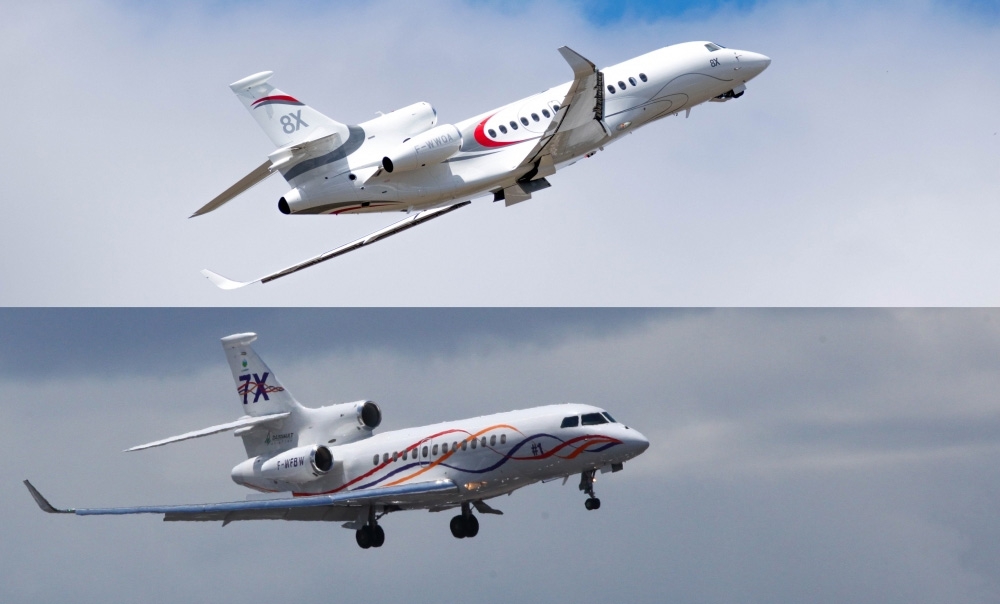
Falcon 7X vs Falcon 8X
Falcon 7X vs Falcon 8X: the differences at a glance
Launched by the French manufacturer Dassault, the Falcon 7X (in service since 2007) and the Falcon 8X (since 2016) both belong to the ultra-long-range category — aircraft with a minimum range of 8,500 km, seating for more than 12 passengers and a cabin at least 1.85 m high. The table below summarises the key specifications.
| Specification | Falcon 7X | Falcon 8X |
|---|---|---|
| Entered service | 2007 | 2016 |
| Range | about 11,019 km (6,850 miles) | 11,945 km (7,420 miles) |
| Engines | 3 × Pratt & Whitney Canada PW307A | 3 × Pratt & Whitney Canada PW307D |
| Maximum speed | Mach 0.90 | Mach 0.90 |
| Cabin length | 11.91 m (39 ft 1 in) | 13.00 m (42 ft 8 in) |
| Cabin height | 1.88 m | 1.88 m |
| Cabin width | 2.34 m | 2.34 m |
| Passengers | up to 16 (typically 12–14) | up to 16 (typically 12–14) |
| Max take-off weight | ≈ 31,750 kg | ≈ 33,110 kg |
Range and routes: the main difference
Autonomy is the decisive difference between the two aircraft. The Falcon 7X offers a range of 11,019 km (6,850 miles) (around 11,019 km) — enough to link Paris to Rio de Janeiro or New York to Moscow non-stop. The Falcon 8X, with an additional fuel tank and more powerful engines, extends this to 11,945 km (7,420 miles), about 8% — roughly 930 km (580 miles) — further.
That extra reach opens up the longest intercontinental city pairs: the 8X can connect Beijing to New York, Singapore to London or São Paulo to Paris without a fuel stop. For most missions the 7X is already a genuine intercontinental aircraft; the 8X earns its place on the very longest sectors and against demanding headwinds.
Cabin and comfort
Both aircraft share the same cabin cross-section: 1.88 m high and 2.34 m wide, among the most generous in their class. The difference lies in length. The Falcon 8X stretches the fuselage by about 1.1 m, taking the cabin from 11.91 m to 13.00 m — an increase of roughly 10% in cabin volume.
In practice, that additional metre gives more flexibility in the layout: a larger lounge, a dedicated rest area or a more spacious galley and crew rest, depending on the configuration. The 8X also benefits from more recent cabin systems, while the 7X remains a reference for space and quiet at a more accessible level.
Engines and performance
Both the 7X and the 8X are powered by three rear-mounted Pratt & Whitney Canada engines — the trijet signature of Dassault's flagship Falcons, which allows long over-water flights with a high level of redundancy. The 8X's PW307D engines are an evolution of the 7X's PW307A, delivering slightly more thrust while reducing fuel burn and noise.
Both cruise at Mach 0.90 and are known for their short-field performance and their ability to fly steep approaches into demanding airports, such as London City. This combination of long range and access to constrained runways is one of the family's strongest assets.
Falcon 7X or Falcon 8X: which to choose?
The Falcon 7X remains one of the most versatile ultra-long-range jets on the market: proven, widely operated, and capable of the great majority of intercontinental missions. The Falcon 8X is the choice when the extra range matters — the longest non-stop sectors — or when the additional cabin length and the latest systems are decisive. There is no single best answer: the right aircraft depends on your routes, your passenger count and your priorities between range, cabin and budget.
Chartering a Falcon 7X or 8X with IBC Aviation
IBC Aviation operates its own Falcon 7X and charters both the 7X and the 8X among other ultra-long-range jets. Our teams help you select the aircraft best suited to your itinerary — from a transatlantic crossing to an intercontinental link — and handle every step, from permits to ground handling. To charter a private jet from our fleet, our teams provide a personalised, all-inclusive quote within the hour. Available 24/7:
- France: +33 1 41 69 88 88
- Switzerland: +41 22 880 28 88
- Email: contact@ibc-aviation.com
Frequently asked questions
What is the difference between the Falcon 7X and the Falcon 8X?
The Falcon 8X is a stretched, longer-range development of the Falcon 7X. It offers about 930 km (580 miles) (roughly 8%) more range, a cabin around 1.1 m longer (13.00 m vs 11.91 m) and upgraded PW307D engines. Both are trijets that cruise at Mach 0.90 and share the same cabin height and width.
Which has the longer range, the 7X or the 8X?
The Falcon 8X, with 11,945 km (7,420 miles) against about 11,019 km (6,850 miles) for the 7X. The 8X can fly the longest city pairs non-stop, such as Beijing–New York or Singapore–London.
How many passengers can the Falcon 7X and 8X carry?
Both typically seat 12 to 14 passengers, and up to 16 depending on the cabin layout. The 8X's longer cabin offers more flexibility in configuration.
Which aircraft is more recent?
The Falcon 8X, which entered service in 2016, nine years after the Falcon 7X (2007). The 8X benefits from more efficient engines and more recent cabin systems.
Can the Falcon 7X and 8X land at London City Airport?
Yes. Both are certified for steep approaches and short runways, which gives them access to demanding airports such as London City — a rare capability for ultra-long-range jets.
How much does it cost to charter a Falcon 7X or 8X?
The price depends on the route, the number of passengers and the dates. As ultra-long-range aircraft, both sit at the upper end of the charter range. IBC Aviation provides a personalised, all-inclusive quote within the hour.