





 +41 22 880 28 88
 +33 1 41 69 88 88 (Paris)
 +352 26 20 25 53 88
 +971 55 303 5161
 +66 92 372 4680

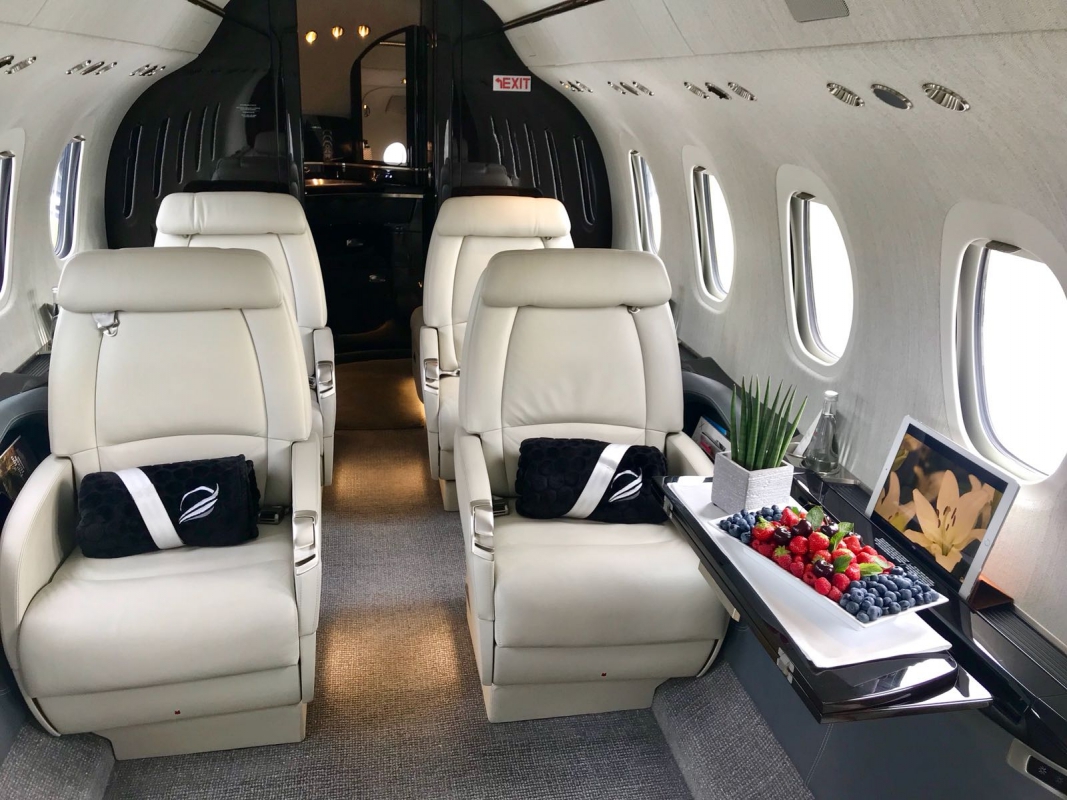
Midsize vs Super Midsize Jet: The Real Difference in 2026
No regulation defines either category
The only official categories that come close are the wake turbulence ones. ICAO uses three main bands: Light up to 7,000 kg, Medium from 7,000 to 136,000 kg, Heavy above that, with a Super category added in 2020. In Europe, many airports also apply RECAT-EU, which replaces those three with six, based on both mass and wingspan.
The direct consequence: from the Citation XLS at around 9,200 kg to the Global 7500 at around 52,100 kg, every business jet falls into one and the same category, Medium. No official boundary separates a midsize from a super midsize. All of them are also certified in the transport category, FAR Part 25 or CS-25, meaning on the same basis.
The charter convention, for its part, puts midsize at around 1.50 to 1.75 m of cabin height for 7 to 9 passengers. Keep that convention to read a brochure, not to pick an aircraft: as you will see, the manufacturers do not follow it themselves.
The manufacturers contradict their own convention
Textron presents the Citation Latitude as a midsize and the Citation Longitude as a super midsize. Embraer classifies the Praetor 500 as midsize and the Praetor 600 as super midsize. So far, so clear.
Except that the Latitude, a midsize according to its maker, has a cabin height of 1.83 m, exactly that of the Longitude the same maker places a rung above. It carries a baggage volume of 3.60 m3, more than the Longitude (3.17 m3), the Gulfstream G300 (3.40 m3) and the Challenger 3500 (3.00 m3), all three classified super midsize. The largest hold in the panel therefore belongs to an aircraft sold as a midsize.
The charter market draws its own conclusions: most brokers, IBC Aviation included, offer the Citation Latitude within their super midsize range, while Textron sells it as a midsize. Neither party is wrong: it is proof that no definition carries authority.
One last example: the Citation Ascend, the newest member of Textron's midsize family, is announced with up to 12 passengers, more than the Latitude and as many as the Longitude.
The numbers, from manufacturer data
Seven aircraft from the segment, as their manufacturers classify and document them. Takeoff distances are published at sea level, in standard atmosphere, at maximum weight.
| Aircraft | Manufacturer class | Range | Cabin H x W x L | Baggage | Takeoff |
| Citation Ascend | midsize | 3,593 km (2,230 miles) | 1.52 m x 1.68 m x 5.64 m | 2.55 m3, 363 kg | 1,158 m |
| Citation Latitude | midsize | 5,000 km (3,110 miles) | 1.83 m x 1.96 m x 6.63 m | 3.60 m3, 565 kg | 1,091 m |
| Praetor 500 | midsize | 6,190 km (3,840 miles) | 1.83 m, length 7.32 m | not published on the same basis | 1,287 m |
| Praetor 600 | super midsize | 7,441 km (4,620 miles) | 1.83 m, length 8.38 m | not published on the same basis | 1,438 m |
| Gulfstream G300 | super midsize | 6,670 km (4,140 miles) at Mach 0.80 | 1.85 m x 2.11 m x 8.41 m | 3.40 m3 | 1,457 m |
| Citation Longitude | super midsize | 6,482 km (4,030 miles) | 1.83 m x 1.96 m x 7.67 m | 3.17 m3, 506 kg | 1,466 m |
| Challenger 3500 | super midsize | 6,297 km (3,910 miles) | 1.83 m x 2.19 m x 7.68 m | 3.00 m3 | 1,474 m |
Read the cabin column top to bottom: height discriminates nothing. Five aircraft out of seven show 1.83 m, whether midsize or super midsize. What actually changes is width, from 1.96 m on the Citations to 2.11 m on the G300 and 2.19 m on the Challenger 3500, and length, from 6.63 m to 8.41 m. In practice: on a wide super midsize, two passengers pass each other in the aisle without contorting, and the seats convert into a berth more comfortably.
The one difference you feel on every flight: the runway
This is the operational criterion that decides, and it never appears in consumer brochures. Between the most demanding midsize in the panel and the least demanding super midsize, the gap is 151 metres. Between the extremes, Citation Latitude at 1,091 m and Challenger 3500 at 1,474 m, it reaches 383 metres. Budget for roughly 150 to 380 m of additional runway depending on which models you compare, not a single threshold.
That gap is paid on the ground. It governs access to short or high-elevation airfields, common in the mountains, on the Mediterranean islands and at some airports close to city centres. An aircraft that gets airborne in 1,091 m opens a network of airports that an aircraft needing 1,474 m closes, at maximum weight. It is often this point, rather than cabin width, that settles the choice on a given itinerary.
Range: read the comparison basis before the figure
Published ranges rest on the NBAA IFR reserve: a missed approach at destination, a climb to 5,000 ft, a five-minute hold, then a flight to an alternate 370 km (230 miles) away. Manufacturers add their own assumptions, usually four passengers, long-range cruise, 85% annual winds, standard atmosphere and a 3% airways allowance.
It is a comparison format, not a planning basis. Two practical consequences. First, an aircraft advertised at 6,482 km (4,030 miles) does not fly 6,482 km (4,030 miles) with eight passengers and their bags. Second, the rankings flip with the reference: the Praetor 500, classified midsize by Embraer, shows 6,190 km (3,840 miles), more than the Challenger 350 (5,930 km (3,680 miles)), still very present in charter, but less than the current Challenger 3500 (6,297 km (3,910 miles)). The G300 is quoted at 6,670 km (4,140 miles) at Mach 0.80 but only 5,560 km (3,450 miles) at Mach 0.84: speed is paid for in distance.
A segment being rebuilt from the ground up
The vocabulary wavers all the more because the range is turning over completely. In five years, several long-standing references have left the production lines.
- Learjet. Bombardier announced the end of production on 11 February 2021. The last Learjet 75 was delivered on 28 March 2022, after 58 years of production, more than 3,000 aircraft built and more than 2,000 still in service, with support maintained.
- Hawker. The Hawker 800 family ceased production in 2013, after around 650 aircraft built since 1983, successively by British Aerospace, Raytheon and then Hawker Beechcraft. The Hawker 900XP, certified in August 2007 and built in 193 examples, is its final evolution.
- Citation X and Sovereign+. The Citation X, then X+, was produced from 1996 to 2018, its end reported in late June 2018. Textron ended the Sovereign+ on 8 March 2021, citing softening demand and overlap with the Latitude and the Longitude.
Facing them, three aircraft are arriving. The Citation Ascend was certified by the FAA on 5 November 2025, after more than 1,000 hours of testing on two aircraft, with a first customer delivery on 30 December 2025. The Gulfstream G300 was unveiled on 30 September 2025 in Savannah and flew for the first time in December 2025, with deliveries targeted in 2027. The Praetor 600E and 500E were unveiled on 24 February 2026: the 600E received triple ANAC, FAA and EASA certification announced on 30 April 2026, with airframe, engines and range unchanged and the changes focused on the cabin; the 500E is expected by the end of 2026.
Demand is following. Honeywell, in its 34th global outlook published on 13 October 2025, forecasts 8,500 business jet deliveries worth USD 283 billion over ten years, its highest in 34 editions. Fractional fleets have grown by more than 65% since 2019 to around 1,300 aircraft, of which 80% are light, midsize and super midsize.
Which aircraft for which flight
Rather than reasoning by label, reason by constraint. Three cases cover most of the requests we handle.
- A European flight of 1 to 3 hours, 6 to 8 passengers, short or high-elevation field. A midsize is ample and opens the widest airport network. This is the most frequent case, from Paris to or from Geneva, Nice, Milan or Munich.
- A 4 to 6 hour flight, a cabin to work or rest in, 8 to 10 passengers. The super midsize takes over, less through range than through cabin width and available length. Typically Europe to or from the Gulf, or busy trans-Mediterranean sectors.
- A transatlantic flight or a genuine need to sleep on board. This is no longer the right segment: look towards long-range jets.
On budget, our indicative hourly brackets start at EUR 4,800 an hour for a midsize and EUR 5,500 for a super midsize, aircraft, crew, fuel, ground handling and navigation charges included, excluding de-icing, added passengers, special catering, wi-fi and airport opening.
IBC Aviation private jet charter:
The right aircraft is not the one in the right category, it is the one that accepts your runway, your passengers and your dates. Our teams advise you on the private jet best suited to your itinerary and your requirements, and arrange your flight to or from any destination. Available 24/7:
- France: +33 1 41 69 88 88
- Switzerland: +41 22 880 28 88
- Dubai: +971 55 303 5161
- Bangkok: +66 92 372 4680
- Email: contact@ibc-aviation.com
Frequently asked questions
What is the difference between a midsize and a super midsize jet?
There is no regulatory definition: both terms are commercial categories, absent from ICAO, FAA and EASA texts. On manufacturer data, cabin height does not separate them, with five aircraft out of seven at 1.83 m. What changes is cabin width, from 1.96 m to 2.19 m, length, from 6.63 m to 8.41 m, and takeoff distance, with a gap of roughly 150 to 380 m depending on the models.
Can a super midsize use every airport a midsize can?
Not always. Takeoff distances published at sea level, in standard atmosphere and at maximum weight range from 1,091 m for the Citation Latitude to 1,474 m for the Challenger 3500. On short or high-elevation fields, that gap closes airports a midsize can still use.
Is the Citation Latitude a midsize or a super midsize?
Both, depending on who is speaking. Textron presents it as a midsize on its product page. Most brokers, IBC Aviation included, offer it as a super midsize, its 1.83 m cabin height and 3.60 m3 baggage hold exceeding those of several aircraft classified super midsize. No definition carries authority.
Can you cross the Atlantic in a super midsize?
Published ranges across the segment run from 6,297 to 7,441 km (3,910 to 4,620 miles), but they rest on the NBAA IFR reserve and on assumptions of four passengers, long-range cruise and average winds. That format is built to compare, not to plan. For a loaded transatlantic, the question belongs to long-range jets and is settled case by case according to payload, route and winds.
How much does an hour cost in a midsize and a super midsize?
As an indication, IBC Aviation brackets start at EUR 4,800 an hour for a midsize and EUR 5,500 for a super midsize, aircraft, crew, fuel, ground handling and navigation charges included. De-icing, added passengers, special catering, wi-fi and airport opening are excluded.