





 +41 22 880 28 88
 +33 1 41 69 88 88 (Paris)
 +352 26 20 25 53 88
 +971 55 303 5161
 +66 92 372 4680

How Does a Jet Engine Work?
The principle: action and reaction
Everything rests on a simple physical principle stated by Newton: every action produces an equal and opposite reaction. A jet engine throws a mass of air and gas rearward at a speed higher than the aircraft's; in return, the aircraft is pushed forward. Thrust arises precisely from this difference: the momentum of the ejected gases, minus that of the air taken in. The more air you accelerate, the greater the thrust.
The four-stage cycle
A jet engine runs through four operations — intake, compression, combustion, expansion — known to engineers as the Brayton cycle. The key difference from a car's piston engine: these four stages do not follow one another in the same place; they happen continuously and simultaneously, each in a dedicated section of the engine. The air never stops: it enters, is compressed, burns, and escapes — without interruption.
The engine's parts, in order
Let's follow the air, front to back:
- The air intake: channels and slows the incoming air.
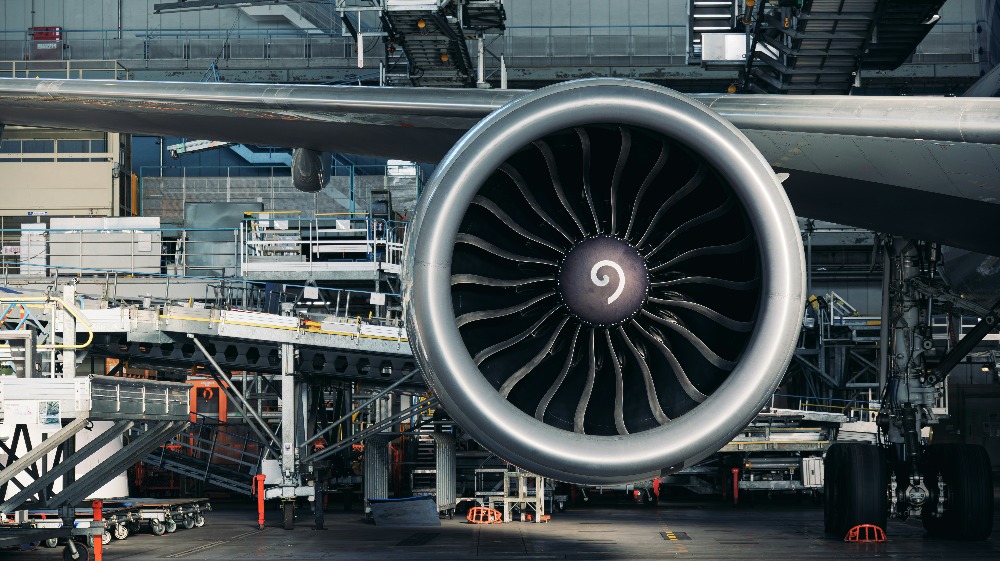
- The fan: a large bladed wheel that draws air in.
- The compressor: a series of blade stages that sharply raise the air's pressure — and therefore its temperature.
- The combustion chamber: fuel is injected and burned; the temperature climbs sharply.
- The turbine: the hot gases pass through it and give up part of their energy.
- The nozzle: it accelerates the gases rearward, faster than they came in.
One essential detail: the turbine and the compressor are linked by a shaft. The gases that spin the turbine thus drive the compressor upstream — the engine sustains itself. Modern engines often use two concentric shafts, turning at different speeds.
Temperatures that exceed the melting point of metal
In the combustion chamber and at the turbine inlet, the gases commonly reach 1,400 to 1,700 °C — more still on the latest engines. That is hotter than the melting point of the alloys the blades are made of. How do they survive? They are hollow and cooled by internal air, and protected by thermal barriers. As for the compressor and turbine, they spin at several tens of thousands of revolutions per minute on smaller engines.
Turbojet, turbofan, turboprop
There are three main families:
- The turbojet: all the air passes through the engine core; thrust comes solely from the exhaust gases. It is the oldest type — today noisy and thirsty.
- The turbofan: a fan sends part of the air around the core — the cold flow — without burning it. Thrust combines this cold flow and the hot flow. It powers virtually every business jet and airliner.
- The turboprop: the turbine is used mainly to drive a propeller; the exhaust gases provide only residual thrust.
Why did the turbofan prevail? By moving a large mass of air at moderate speed rather than a thin, very fast jet, it lowers the exhaust velocity. The result: less noise — a jet's roar rises very quickly with exhaust velocity — and lower fuel consumption. The proportion of bypassed air has a name, the bypass ratio: around 4 to 5 on a business jet, hence compact engines, against 9 to 12 on a wide-body airliner.
What is thrust?
Thrust is the force that propels the aircraft. It is measured in newtons, most often in kilonewtons (kN) for an aircraft engine; technical data sheets also use the pound-force (lbf), and the decanewton (daN) appears too. For reference, 1 kN equals about 225 lbf. For a turboprop, one speaks of power — in kilowatts or horsepower — rather than thrust.
And in business aviation?
Business jets are fitted with moderate-bypass turbofans: compact, they favour speed and altitude. For shorter trips or demanding airfields, some aircraft rely on turboprops, more economical at lower speed. Safety, in turn, rests partly on redundancy: multiple engines, strict maintenance and generous design margins. To find out which aircraft — and which engine — suits your trip, explore our fleet or request a private jet charter quote. Our teams reply within the hour, 24/7:
- France: +33 1 41 69 88 88
- Switzerland: +41 22 880 28 88
- Email: contact@ibc-aviation.com
Frequently asked questions
How does a jet engine work?
It draws in air, compresses it, mixes it with fuel that it ignites, then ejects the hot gases rearward at high speed. That ejection creates, by reaction, a forward force: thrust.
What is the difference between a turbojet and a turbofan?
In a turbojet, all the air passes through the engine core. In a turbofan, a fan bypasses part of the air around the core; this cold flow makes the engine quieter and more economical. Virtually all business jets are turbofans.
Why is a jet engine so loud?
Jet noise rises very quickly with exhaust velocity. High-bypass engines, which move a great deal of air at moderate speed, are far quieter than the old turbojets.
How hot does a jet engine get?
At the turbine inlet, the gases commonly exceed 1,400 to 1,700 °C — hotter than the melting point of the blade metal, which is why the blades are internally cooled and coated with thermal barriers.
What is thrust, and in what unit is it measured?
It is the engine's propulsive force. It is expressed in newtons, usually in kilonewtons (kN); anglophone data sheets use the pound-force (lbf). 1 kN equals about 225 lbf.
Turboprop or jet: what's the difference?
A jet draws its thrust from the ejected gases; a turboprop uses the turbine to drive a propeller. The turboprop is often more economical at low speed and on short trips, the jet faster and more at home at altitude.