


 +41 22 880 28 88
 +33 1 41 69 88 88 (Paris)
 +352 26 20 25 53 88
 +971 55 303 5161
 +66 92 372 4680

Dassault Aviation: history, Rafale and the Falcon range
Marcel Dassault, from Bloch to Dassault
The manufacturer owes its name to its founder, Marcel Dassault, born Marcel Bloch in Paris in 1892. A graduate of the École supérieure d'aéronautique in 1913, he made his name during the First World War by designing the Éclair propeller, fitted to several Allied aircraft, and by contributing to the SEA 4 two-seat fighter. After a spell in real estate during the 1920s, he returned to aviation in the early 1930s.
The Second World War marked a turning point. Refusing to collaborate, Marcel Bloch was imprisoned and then deported to Buchenwald, which he survived. It was during this period that the name Dassault took shape: it draws on Chardasso, the Resistance pseudonym of his brother, General Darius Paul Bloch, itself derived from the French char d'assaut, meaning assault tank. The name was officially adopted in 1949. A major figure in French industry, Marcel Dassault died in 1986.
From 1929 to today: the manufacturer's history
The industrial venture began in 1929 with the Société des Avions Marcel Bloch. Like part of the French aerospace industry, the company was nationalised in the late 1930s. After the war, Marcel Dassault refounded his business as Avions Marcel Dassault in 1947, and the manufacturer then produced the run of military programmes that built its reputation.
The merger with Breguet in 1971 created Avions Marcel Dassault-Breguet Aviation, before the company took its current name, Dassault Aviation, in 1990. In parallel, the civil Falcon range, launched in the 1960s, made the military manufacturer a major name in business aviation.
| Year | Milestone |
| 1929 | Société des Avions Marcel Bloch founded |
| 1947 | Refounded as Avions Marcel Dassault |
| 1949 | First flight of the Ouragan, France's first series-production jet fighter |
| 1963 | First flight of the Mystère 20, origin of the Falcon range |
| 1971 | Merger with Breguet (Dassault-Breguet) |
| 1978 | First flight of the Mirage 2000 |
| 1986 | First flight of the Rafale A demonstrator |
| 1990 | The company takes the name Dassault Aviation |
| 2023 | Falcon 6X certification |
| 2025 | Delivery of the 300th Rafale |
Dassault Aviation today
Dassault Aviation is a company listed on Euronext Paris and chaired by Éric Trappier. Its capital remains controlled by the Groupe Industriel Marcel Dassault (GIMD), while Airbus holds a minority stake, with the rest made up of the free float. The manufacturer designs its aircraft in the Paris area and assembles them mainly at Mérignac, in the Gironde, as well as at several other French sites.
Driven by Rafale exports and by the ramp-up of the Falcon range, the group reported 2025 revenue of 7.42 billion euros, sharply higher, with an order book of 46.6 billion euros at the end of the year. The key figures below give an overview of the manufacturer.
| Headquarters | Saint-Cloud (Paris area) |
| Main assembly site | Mérignac, near Bordeaux |
| Chairman and CEO | Éric Trappier |
| Listing | Euronext Paris |
| Shareholding | GIMD 66.86% of capital, Airbus 10.65%, free float 22.30% |
| 2025 revenue | 7.42 billion euros |
| Order book | 46.6 billion euros (end of 2025) |
| Workforce | around 14,600 people |
| 2025 deliveries | 26 Rafale and 37 Falcon |
What is the difference between Dassault Aviation and Dassault Systèmes?
A common confusion sets Dassault Aviation against Dassault Systèmes. Both companies belong to the wider Dassault Group, but their businesses are entirely different and they are listed separately. Dassault Aviation builds aircraft. Dassault Systèmes, spun off from Dassault Aviation in 1981, develops three-dimensional design and simulation software, starting with CATIA and then the 3DEXPERIENCE platform, used in aerospace as well as in the automotive and life-sciences sectors. Put simply, one builds the aircraft, the other develops the digital tools used to design them.
Dassault's military aircraft
The manufacturer's reputation was first built on its combat aircraft. From the Ouragan, France's first series-production jet fighter in 1949, Dassault produced one programme after another: the Mystère and Super Mystère, then the famous Mirage line, from the Mirage III to the Mirage 2000, by way of the Mirage IV, a carrier of France's nuclear deterrent, and the Mirage F1. The carrier-borne Super Étendard rounds out this heritage.
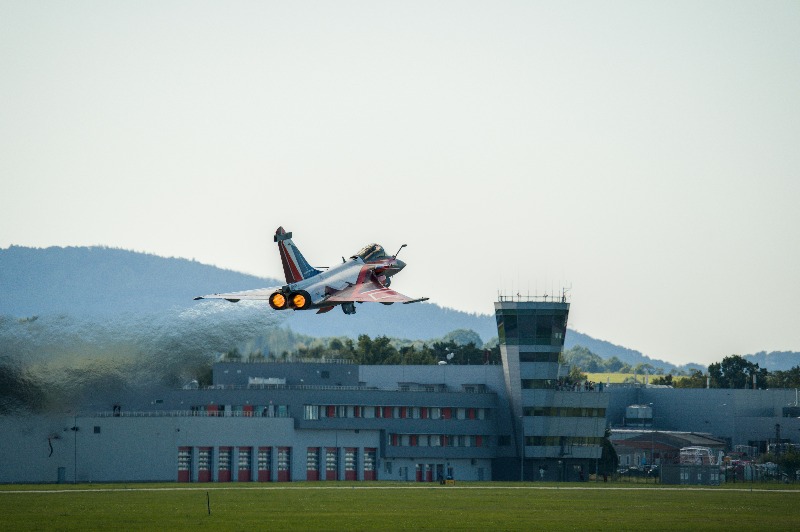
Today, the flagship programme is the Rafale, an omnirole combat aircraft able to handle air superiority, ground strike, reconnaissance, anti-ship missions and nuclear deterrence alike. Stemming from a demonstrator that flew as early as 1986, the Rafale entered service with the French Navy in 2004 and then with the Air Force in 2006. Its success has been confirmed on the export market: the 300th aircraft was delivered on 7 October 2025, bringing the total to 533 firm orders from France and eight client countries.
| Country | Rafale ordered | Note |
| Egypt | 54 | first export customer, from 2015 |
| Qatar | 36 | 2015 |
| India (Air Force) | 36 | 2016 |
| India (Navy) | 26 Rafale Marine | 2025 |
| Greece | 24 | 2021 |
| Croatia | 12 | 2021 |
| United Arab Emirates | 80 | 2021, largest export order |
| Indonesia | 42 | 2022 to 2024 |
| Serbia | 12 | 2024 |
The manufacturer is also exploring the systems of tomorrow. The nEUROn, a stealth combat-drone demonstrator led by Dassault with several European partners, flew for the first time in 2012. Dassault also runs surveillance missions using militarised Falcons: three Falcon 8X "Archange" signals-intelligence aircraft for the French Air and Space Force, whose first flight took place in July 2025, and the Albatros maritime-surveillance programme, based on the Falcon 2000, for the French Navy. The Atlantique 2 maritime patrol aircraft completes the defence range.
FCAS: a Franco-German programme halted
Dassault Aviation was at the heart of the Future Combat Air System (FCAS, or SCAF in French), a project bringing together France, Germany and Spain around a next-generation combat aircraft intended to succeed the Rafale and the Eurofighter. On 8 June 2026, according to several specialist media, France and Germany ended the programme, amid persistent disagreement between Dassault and Airbus over industrial workshare and leadership of the fighter. Cooperation on other building blocks, such as remote carriers, is still being discussed. This case illustrates the tensions specific to major European defence programmes, where questions of sovereignty weigh as heavily as the technology.
The Falcon range, business aviation the Dassault way
Dassault's civil side is embodied in the Falcon range, which carries the manufacturer's military know-how over into business aviation. It all began with the Mystère 20, which flew in 1963. Spotted by Pan Am, which marketed it as the "Fan Jet Falcon", the aircraft became the Falcon 20 and was an immediate success across the Atlantic. It was on this basis that Frederick Smith launched the FedEx courier company in 1973, with a fleet of Falcon 20s adapted for cargo.
The range then grew with the Falcon 50, the first business trijet in 1976, followed by the Falcon 900 and Falcon 2000. In 2005, the Falcon 7X broke new ground by becoming the first business jet with fully fly-by-wire flight controls, a technology inherited from the Rafale. It was followed by the Falcon 8X, then the Falcon 6X, certified in 2023, which offers one of the most spacious cabins in its category. The future Falcon 10X, in development, is targeting a maiden flight in 2026 and entry into service in late 2027, with the widest cabin ever designed for a business jet and new Rolls-Royce Pearl 10X engines. In all, more than 2,700 Falcons have been delivered since 1963.
| Model | Type | Note |
| Falcon 20 | twinjet | first Falcon, 1963 |
| Falcon 50 | trijet | first business trijet, 1976 |
| Falcon 900 | trijet | long-range business aircraft |
| Falcon 2000 | twinjet | wide-body business aircraft |
| Falcon 7X | trijet | first business jet with fully fly-by-wire controls, 2005 |
| Falcon 8X | trijet | stretched derivative of the 7X |
| Falcon 6X | twinjet | certified in 2023, very spacious cabin |
| Falcon 10X | twinjet | in development, maiden flight targeted for 2026 |
To explore the civil side further, you can read our feature on the Falcon range by Dassault, as well as our dedicated pages on the Falcon 6X and the Falcon 900EX. The recent history of the range also includes the Falcon 5X, a project abandoned because of engine difficulties and replaced by the Falcon 6X.
Chartering a Falcon with IBC Aviation
While Dassault builds the aircraft, IBC Aviation arranges your flight aboard them. As an independent broker, we operate no aircraft of our own: we compare the Falcons and other jets available on the market for your date and your trip, then arrange the entire flight. The Falcon 6X, 7X, 8X, 2000 and 900 are among the most requested aircraft on intercontinental routes, for their range, cabin and comfort.
To prepare a trip, browse our aircraft fleet, discover the framework of our role on our private jet charter page, and understand how a quote is built on our page about the cost of renting a private jet. We produce a tailored, all-inclusive quote, usually in under an hour. Available 24/7:
- France: +33 1 41 69 88 88
- Switzerland: +41 22 880 28 88
- Dubai: +971 55 303 5161
- Bangkok: +66 92 372 4680
- Email: contact@ibc-aviation.com
Frequently asked questions
Who founded Dassault Aviation?
The manufacturer was founded by Marcel Dassault, born Marcel Bloch in 1892 and died in 1986. An engineer and industrialist, he created the Société des Avions Marcel Bloch in 1929, refounded as Avions Marcel Dassault in 1947.
Why did Marcel Bloch take the name Dassault?
The name Dassault draws on Chardasso, the Resistance pseudonym of his brother, General Darius Paul Bloch, itself derived from the French char d'assaut, meaning assault tank. It was officially adopted in 1949.
What aircraft does Dassault Aviation build?
Dassault Aviation designs military aircraft, including the Rafale, the Mirage line and the nEUROn drone demonstrator, as well as civil business jets, the Falcon range (Falcon 6X, 8X, 2000, 900 and the future Falcon 10X).
What is the difference between Dassault Aviation and Dassault Systèmes?
Dassault Aviation builds aircraft. Dassault Systèmes, spun off from Dassault Aviation in 1981, develops three-dimensional design software such as CATIA and the 3DEXPERIENCE platform. Both companies belong to the wider Dassault Group but are distinct and listed separately.
Who owns Dassault Aviation?
The Groupe Industriel Marcel Dassault (GIMD) holds 66.86% of the capital and 80.10% of the voting rights, as of 6 March 2026. Airbus holds 10.65% and the free float represents 22.30%. The company is listed on Euronext Paris.
Does Dassault build the Rafale?
Yes. The Rafale is designed and assembled by Dassault Aviation, the prime contractor for the programme, with Thales for the electronics and Safran for the engine. The 300th Rafale was delivered on 7 October 2025, for a total of 533 firm orders from France and eight export countries.
What is Dassault's latest Falcon?
The Falcon 6X, certified in 2023, is the latest model to enter service. The Falcon 10X is in development, with a maiden flight targeted for 2026 and entry into service in late 2027; it will offer the widest cabin in its category.
Where is Dassault Aviation's headquarters?
The headquarters are in the Paris area, at Saint-Cloud, and the main assembly site is at Mérignac, near Bordeaux.