





 +41 22 880 28 88
 +33 1 41 69 88 88 (Paris)
 +352 26 20 25 53 88
 +971 55 303 5161
 +66 92 372 4680

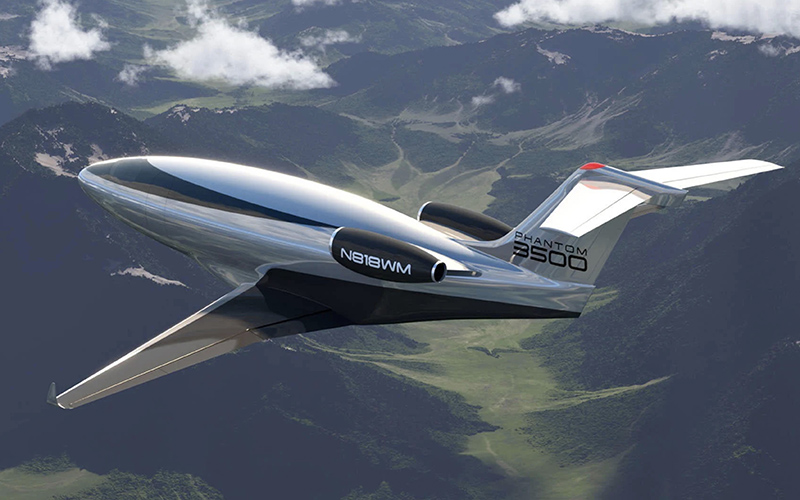
Phantom 3500: The Windowless Private Jet Promising 60% Less Fuel
What the FAA has (really) just decided
On 8 June 2026, Otto Aerospace announced the closure of the Phantom 3500's "G-1 Issue Paper": the FAA and the manufacturer have agreed on the aircraft's certification basis, under Part 23 regulations. In practical terms, the "rulebook" the aircraft must comply with is now set — a structuring step for an all-new programme. It is, however, neither a certification nor an authorisation to fly: the next step, known as G-2, will define how the manufacturer demonstrates compliance. A certification applicant since September 2025, Otto chose Part 23 — which covers aircraft of up to 19 seats and about 8.6 tonnes — and sized its aircraft accordingly.
Why a jet with no windows?
It all stems from a radical aerodynamic choice: full laminar flow. On a conventional subsonic aircraft, the friction of air over the surfaces accounts for about 45% of total drag, according to NASA research. By keeping the airflow smooth — laminar — over the fuselage as well as the wings, that friction drops dramatically. But laminarity tolerates no imperfection: no rivets, no panel joints… and no windows. Glazed openings trip the airflow and require heavy structural reinforcement. By removing them, Otto says it preserves laminarity and significantly lightens its all-composite fuselage. The cockpit, for its part, keeps its windshield.
What do passengers see on board?
In place of windows, the cabin is lined with large high-definition displays — a system named "Super Natural Vision" — fed in real time by exterior cameras. The walls show the sky and the landscape as if through wide virtual bay windows, with adjustable brightness. Virtual-window cabins already fly, incidentally, on some commercial routes. There remain the question of passenger acceptance — and the more technical ones of emergency evacuation and the electrical redundancy of those screens: precisely the points the certification phase will have to settle.
The promise: up to 60% less fuel
The chain of gains announced by Otto runs as follows: about 35% less drag, therefore smaller, lighter engines, therefore a cascade of weight savings — up to 60%, even 61%, less fuel than comparable super-midsize jets. The manufacturer quotes an hourly consumption of about 115 gallons, against around 300 for competing aircraft with a similar cabin, and, combined with sustainable aviation fuel (SAF), a CO2 emissions reduction of more than 90%. An essential caveat: these figures are manufacturer targets, derived from calculations and wind-tunnel testing — the aircraft has not yet flown, and they remain to be validated in flight test. To understand the underlying mechanics, see our article on how a jet engine works.
The Phantom 3500 in figures (manufacturer targets)
| Characteristic | Announced value |
| Range | up to about 6,500 km (4,040 miles) |
| Cruise speed | Mach 0.78 to 0.80 |
| Ceiling | 51,000 ft (~15,500 m) |
| Passengers | up to 9 |
| Cabin height | 1.96 m, flat floor |
| Maximum take-off weight | ~8,618 kg (under the Part 23 limit) |
| Engines | 2 × Williams FJ44-4, 100% SAF-compatible |
| Announced fuel burn | up to 60% less than a comparable super-midsize |
| First flight target | 2027 |
| Entry into service target | 2030 |
The promise fits in one sentence: a super-midsize cabin, at the weight — and, Otto hopes, the cost — of a light jet.
Where does this aircraft come from?
Otto Aerospace does not come from nowhere. Founded in 2008, the company flew a demonstrator between 2018 and 2021, the Celera 500L, a teardrop-shaped airframe dedicated to validating laminar flow — some fifty flights, with self-reported results. The Phantom 3500, unveiled in 2025, is its commercial culmination: headquarters in Fort Worth, Texas, final assembly and flight testing planned in Jacksonville, Florida, and an all-composite fuselage entrusted to a major European manufacturer. The preliminary design review was completed in spring 2026, and a first order for 300 aircraft — valued at more than 5 billion dollars — has already been announced.
The takeaway — with caution
Business aviation has everything to gain from a fuel-burn breakthrough of this magnitude: operating costs, carbon footprint, access to shorter runways. But the sector's history calls for restraint: all-new aircraft programmes routinely slip by several years, and every Phantom 3500 figure remains, at this stage, a promise to be demonstrated in flight and then in certification. First flight targeted for 2027, entry into service for 2030: the rendezvous is set.
And in the meantime?
The Phantom 3500 is a 2030s horizon, not an aircraft you can charter today. In the interval, IBC Aviation follows these innovations closely and selects, within our fleet and its network, the most efficient recent aircraft suited to each mission. To charter a private jet, to or from any destination, our teams provide a personalised, all-inclusive quote within the hour. Available 24/7:
- France: +33 1 41 69 88 88
- Switzerland: +41 22 880 28 88
- Dubai: +971 55 303 5161
- Bangkok: +66 92 372 4680
- Email: contact@ibc-aviation.com
Frequently asked questions
What is the Phantom 3500?
A business jet under development at American manufacturer Otto Aerospace: a full laminar-flow airframe, a windowless cabin, up to 9 passengers and an announced range of 6,500 km (4,040 miles). First flight targeted for 2027, entry into service for 2030.
Why does this jet have no windows?
Windows trip the laminar airflow over the fuselage and require heavy structural reinforcement. By removing them, the manufacturer preserves laminarity — and the drag reduction — while lightening the aircraft. The cockpit keeps its windshield.
What do passengers see on board?
Large high-definition displays, named "Super Natural Vision", relay in real time the images from exterior cameras, like virtual bay windows.
Does the Phantom 3500 really burn 60% less fuel?
That is the figure announced by Otto Aerospace — up to 61% against comparable super-midsize jets — based on calculations and wind-tunnel testing. The aircraft has not yet flown: the promise remains to be validated in flight test.
Has the FAA certified the Phantom 3500?
No. On 8 June 2026, the FAA set its certification basis (closure of the G-1, Part 23): the regulatory framework is fixed, but the demonstration of compliance and the certification are still to come.
When will the Phantom 3500 enter service?
The manufacturer targets a first flight in 2027 and entry into service in 2030. That timeline is a company objective; all-new aircraft programmes frequently slip.
Can you already charter a Phantom 3500?
No, the aircraft exists only as a programme. In the meantime, IBC Aviation selects the most efficient recent aircraft from its fleet and network for each mission.