





 +41 22 880 28 88
 +33 1 41 69 88 88 (Paris)
 +352 26 20 25 53 88
 +971 55 303 5161
 +66 92 372 4680

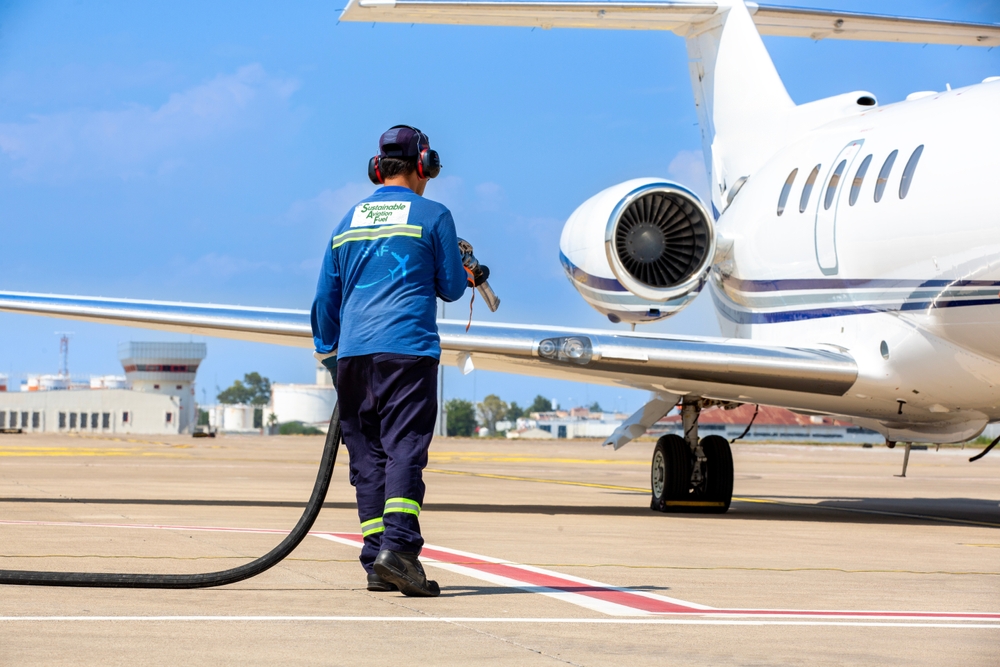
Sustainable Aviation Fuel (SAF): What You Need to Know
What is SAF?
SAF is a cleaner alternative to fossil kerosene (Jet A-1). Where traditional kerosene is refined from oil, SAF is produced from renewable resources:
- used cooking oils and animal fats;
- agricultural and forestry waste;
- municipal solid waste;
- synthetic fuels from carbon capture, known as "e-fuels" or power-to-liquid.
Chemically very close to kerosene, it replaces it without changing the nature of the flight.
How much does SAF cut emissions?
SAF's strength lies in its life-cycle balance — from production to combustion. According to IATA, it cuts CO2 emissions by up to about 80% over the life cycle for the currently dominant pathway (used oils, known as HEFA), and more — over 90% — for the most advanced synthetic fuels. It also contains fewer impurities, such as sulphur, which limits fine-particle emissions. One clarification is needed: these gains apply over the full life cycle; at combustion, SAF emits an amount of CO2 comparable to kerosene — the reduction comes from carbon capture upstream, during biomass growth or direct capture.
A "drop-in" fuel, with no aircraft modification
SAF is described as "drop-in": ready to use, it blends with kerosene and works in existing engines, with no technical modification.
- Safety: it meets the same strict safety and performance standards as Jet A-1.
- Logistics: it uses the refuelling infrastructure already in place at airports.
To date, aircraft are certified for a blend of up to 50% SAF; engine and aircraft manufacturers are targeting 100% compatibility by the end of the decade. To understand how this fuel burns in the engine, see our article on how a jet engine works.
Market reality: a gradual ramp-up
SAF is not a distant concept — but it remains scarce. In 2025, its production reached about 1.9 million tonnes, double 2024… and still only around 0.6% of global jet fuel, according to IATA. The main constraint is not technology but supply: production struggles to keep pace with demand, and SAF costs significantly more than kerosene. Saying this plainly is part of an honest approach to decarbonisation: SAF is a real lever available today, but it is part of a transition, not an instant switch.
The regulatory framework: the ReFuelEU mandate
To accelerate, the European Union has required, since 1 January 2025, a minimum share of SAF in the fuel uplifted at European airports, through the ReFuelEU Aviation regulation. The trajectory rises:
| Year | Minimum SAF share (EU airports) |
| 2025 | 2% |
| 2030 | 6% |
| 2035 | 20% |
| 2050 | 70% |
This obligation adds to other pressures on the sector, such as taxation — see our article on the French private jet tax.
Book and claim: funding SAF even remotely
SAF is not physically available at every airport. The mechanism known as "book and claim" decouples the purchase of the fuel from its delivery: you fund a quantity of SAF uplifted elsewhere in the global network, and claim its emissions reduction, in a traced and certified way. This is what makes using SAF possible whatever your departure point, without waiting for every airport to be supplied.
SAF with IBC Aviation
Reducing a flight's footprint without giving up the flexibility of private aviation: that is the balance we help our clients strike. IBC Aviation integrates SAF into missions where possible and steers towards the most efficient aircraft in our fleet — engines and aerodynamics weigh as much as fuel in a flight's balance. To charter a private jet and explore the SAF option on your next trip, to or from any destination, our teams provide a personalised, all-inclusive quote within the hour. Available 24/7:
- France: +33 1 41 69 88 88
- Switzerland: +41 22 880 28 88
- Dubai: +971 55 303 5161
- Bangkok: +66 92 372 4680
- Email: contact@ibc-aviation.com
Frequently asked questions
What is SAF (Sustainable Aviation Fuel)?
A fuel produced from renewable resources — used oils, waste, captured carbon — chemically close to kerosene, which cuts a flight's CO2 emissions over its full life cycle.
How much does SAF cut CO2 emissions?
According to IATA, by up to about 80% over the life cycle for the dominant pathway (used oils), and over 90% for the most advanced synthetic fuels.
Do you need to modify the aircraft to use SAF?
No. SAF is "drop-in": it blends with kerosene and works in existing engines, with no modification, up to a 50% blend currently certified.
Is SAF already available?
Yes, but in still-limited quantities: its production accounted for only about 0.6% of global jet fuel in 2025, according to IATA. Supply is the main constraint.
Does SAF cost more than kerosene?
Yes, significantly, due to still-limited production. The premium will narrow as production capacity grows.
What is the ReFuelEU mandate?
A European regulation requiring, since 2025, a minimum share of SAF on departures from EU airports: 2% in 2025, 6% in 2030, 20% in 2035 and 70% in 2050.
What is "book and claim"?
A mechanism that decouples the purchase of SAF from its physical delivery: you fund SAF uplifted elsewhere in the network and claim its emissions reduction, in a traced and certified way.