





 +41 22 880 28 88
 +33 1 41 69 88 88 (Paris)
 +352 26 20 25 53 88
 +971 55 303 5161
 +66 92 372 4680

Croatia by private jet: Adriatic coast, islands and access
Flying to Croatia by private jet
The country has several airports suited to business aviation, from the Dalmatian coast to Istria. Your choice depends on the region and islands you intend to reach.
| Airport | Code | Region and access |
| Split | SPU | Central Dalmatia: Split, Trogir, islands of Hvar, Brač, Vis |
| Dubrovnik | DBV | South: Dubrovnik, Pelješac, Korčula |
| Zadar | ZAD | Northern Dalmatia: Zadar, Kornati, Plitvice Lakes |
| Pula | PUY | Istria: Rovinj, Poreč |
| Zagreb | ZAG | Capital and inland Croatia |
| Brač | BWK | Brač island, near Bol (light jets only) |
One important note: during the summer high season, Split and Dubrovnik operate as coordinated airports with schedule facilitation. Arrival and departure slots, as well as aircraft parking, must be confirmed in advance — a flight plan alone is not sufficient. To understand how this works, see our article on airport slots and air traffic regulation and our guide to airport operational restrictions.
| From | To Split or Dubrovnik | Approximate flight time |
| Paris | Croatian coast | approximately 1h45 to 2h |
| Geneva | Croatian coast | approximately 1h15 to 1h30 |
| Nice | Croatian coast | approximately 1h to 1h15 |
| London | Croatian coast | approximately 2h to 2h30 |
These routes are most commonly served by light jets and midsize aircraft, which you can explore in our aircraft fleet.
Cities and islands to discover
Croatia unfolds from the Istrian peninsula down to southern Dalmatia, with strikingly different atmospheres along the way. Here are the most memorable stops for an exceptional stay.
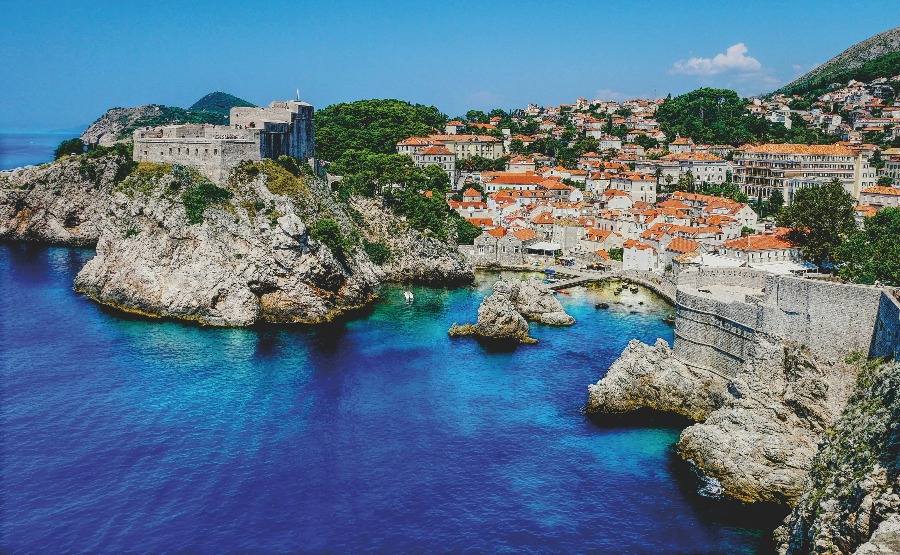
- Dubrovnik: the fortified medieval city known as the "Pearl of the Adriatic" and the principal gateway to the south.
- Split: Croatia's second city, built around Diocletian's Palace, and the base for reaching the Dalmatian islands.
- Hvar: the sophisticated island with lavender fields, a lively harbour, and a favoured anchorage for superyachts.
- Korčula: a small walled island town celebrated for its wines and medieval atmosphere.
- Brač: home to the celebrated Zlatni Rat beach near the village of Bol.
- Rovinj and Istria: the peninsula with its Venetian character, hilltop villages, truffles, and olive oil.
- Zadar and Šibenik: on the northern coast, between Roman ruins, a UNESCO-listed cathedral, and access to the Kornati archipelago.
- Trogir: a small stone island-town a few minutes from Split airport.
- Zagreb and Plitvice Lakes: the inland capital and the national park of terraced lakes and waterfalls.
UNESCO World Heritage Sites
Croatia has ten sites inscribed on the UNESCO World Heritage List, most of them on or near the coast. The most iconic include:
- The Old City of Dubrovnik and the Diocletian's Palace in Split, both listed since 1979.
- Plitvice Lakes National Park (1979), with sixteen terraced lakes and cascading waterfalls.
- The Cathedral of St James in Šibenik and the Historic City of Trogir.
- The Stari Grad Plain on the island of Hvar and the Episcopal Complex of the Euphrasian Basilica in Poreč, in Istria.
Experiences, beaches and dining
Croatia's defining experience remains sailing through the Dalmatian archipelago: from Split or Dubrovnik, a yacht or helicopter allows you to move effortlessly between Hvar, Brač, Korčula, and Vis. Dubrovnik's Old City — famously used as a filming location for Game of Thrones — and the Zlatni Rat beach on Brač are among the country's most iconic images.
At the table, Croatian gastronomy stands out for Istrian truffles, oysters from Ston on the Pelješac peninsula with its renowned wines, and the fish and seafood of the Adriatic. For accommodation, the country hosts some outstanding addresses: the Hotel Excelsior and Villa Dubrovnik in Dubrovnik, Maslina Resort on Hvar, the Grand Park Hotel Rovinj in Istria, and Lešić Dimitri Palace on Korčula. Our team can incorporate these stages into the full preparation of your trip.
When to visit Croatia
The Adriatic season runs from May to September, with peak demand in July and August when the sea is at its warmest. June and September offer an excellent balance: comfortable sea temperatures, fewer crowds, and better availability of slots and aircraft parking. At the July–August peak, early planning becomes all the more essential as Split and Dubrovnik are heavily congested.
Planning your trip to Croatia with IBC Aviation
As an independent broker, IBC Aviation compares available aircraft on the market and handles every element of your journey to or from Croatia: the flight, slots, parking, and transfers to the islands. Our teams anticipate the specific constraints of the Adriatic high season to secure your schedule. You can learn more about our approach on our private jet charter page and browse our destinations.
IBC Aviation private jet charter:
Our teams advise you on the most suitable aircraft for your itinerary and requirements, and organise your journey to Croatia. Available 24/7:
- France: +33 1 41 69 88 88
- Switzerland: +41 22 880 28 88
- Dubai: +971 55 303 5161
- Bangkok: +66 92 372 4680
- Email: contact@ibc-aviation.com
Frequently asked questions
Can you fly to Croatia by private jet?
Yes. The main business aviation gateways are Split (SPU) and Dubrovnik (DBV) on the coast, Zagreb (ZAG) inland, along with Zadar, Pula, and the island airport of Brač, which is restricted to light jets.
Which airports serve private jets in Croatia?
Split and Dubrovnik are the two main coastal gateways; Brač offers an airfield closest to Bol and Hvar, for light jets only. In summer, Split and Dubrovnik are coordinated airports: slots and parking must be confirmed in advance.
How long is the flight from Paris to Croatia by private jet?
Allow approximately 1h45 to 2h to Split or Dubrovnik from Paris, around 1h15 to 1h30 from Geneva, 1h to 1h15 from Nice, and 2h to 2h30 from London, depending on the aircraft and conditions.
Which cities and islands are worth visiting in Croatia?
Dubrovnik, Split, Hvar, Korčula, Brač, Rovinj and Istria, as well as Zadar, Šibenik, and Trogir. Inland, Zagreb and Plitvice Lakes National Park are well worth the detour.
What are Croatia's UNESCO World Heritage Sites?
Croatia has ten UNESCO sites, including the Old City of Dubrovnik, Diocletian's Palace in Split, Plitvice Lakes, the Cathedral of St James in Šibenik, the City of Trogir, the Stari Grad Plain on Hvar, and the Euphrasian Basilica in Poreč.
What is the best time to visit Croatia?
The season runs from May to September, with a peak in July and August. June and September offer a warm sea, fewer crowds, and better slot availability.
Can you visit several islands from a single airport?
Yes. From Split or Dubrovnik, the Dalmatian archipelago — including Hvar, Brač, Korčula, and Vis — is accessible by yacht or helicopter. Our teams handle the logistics to and from the airport.