





 +41 22 880 28 88
 +33 1 41 69 88 88 (Paris)
 +352 26 20 25 53 88
 +971 55 303 5161
 +66 92 372 4680

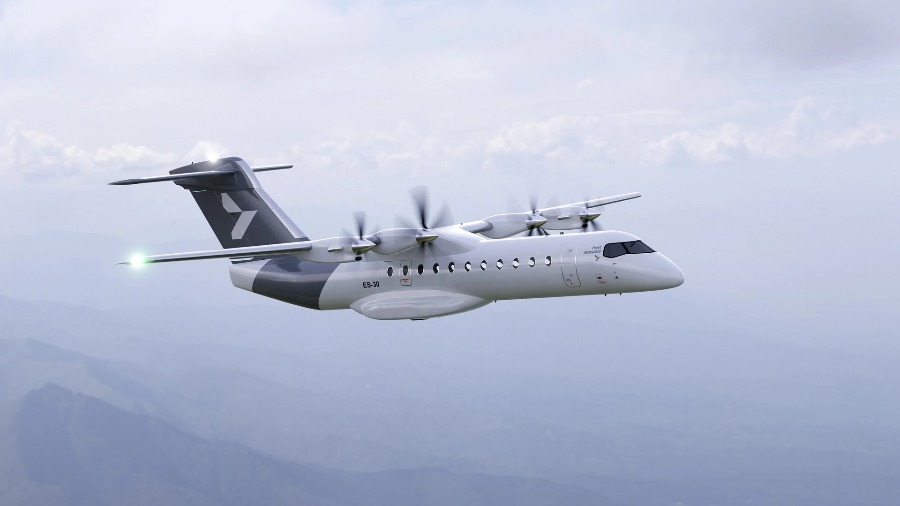
Heart ES-30: 30 Seats, 200 km Electric, Targeting 2031
The X1's first flight, and why it matters
The X1 is no mock-up: it is a full-scale airframe of the ES-30, with a 32-metre wingspan, 23 metres from nose to tail and more than 11 tonnes at take-off. On this first piloted flight, its all-electric powertrain delivered over one megawatt as the aircraft climbed to about 1,100 feet above the ground.
Electric flight was not new in itself, but it had been confined to small trainers and light prototypes. Getting an airframe of this size airborne on batteries is an engineering milestone: battery mass, cooling and the management of a megawatt of power are precisely the hard problems of commercial electric flight.
ES-30: the announced specifications
| Capacity | 30 passengers |
| Propulsion | 4 battery-powered electric motors, 2 SAF-compatible turbogenerators |
| All-electric range | 200 km |
| Hybrid range | 400 km with 30 passengers, 800 km with 25 |
| ES-30 flight testing | announced for 2028 |
| Entry into service | targeted for 2031 |
These figures come from the manufacturer; they remain to be proven in flight test, and the programme's timeline has already shifted in the past.
Fully electric? Not quite, and deliberately so
The ES-30 is often described as an all-electric aircraft. Its architecture is in fact hybrid: batteries alone carry it up to 200 km, while two turbogenerators running on sustainable aviation fuel take over beyond that and provide the regulatory reserves required for a diversion.
The choice is pragmatic. Today's battery energy density cannot move 30 passengers across full regional sectors while carrying certification reserves. Hybridisation delivers most of the gain where it concentrates, on short stages, without giving up safety margins or operational flexibility. Our article on SAF covers the other half of that equation.
What the ES-30 would change on short sectors
A 400 km hybrid range covers city pairs such as Paris-Geneva or Nice-Milan. That is regional turboprop territory, where noise and energy cost per seat weigh heaviest, and where turboprops remain the benchmark today.
For business aviation the horizon sits further out than for regional airlines, but it is real: a quiet, efficient 30-seat module would be a natural tool for group charter, from sports teams to corporate seminars. A reduced noise footprint also speaks directly to urban airports and curfew-bound platforms.
The programme belongs to a wider transition, from sustainable fuel to new propulsion, which we follow in our article on green alternatives in business aviation.
Who stands behind the programme
Heart Aerospace reports 9.4 billion dollars in customer commitments, led among others by United Airlines and Air Canada. Founded in Sweden, the company now builds its first pre-production ES-30 at its pilot plant in Los Angeles, while the X1 continues its test campaign from Plattsburgh.
Caution remains warranted: no electric aircraft of this capacity has ever been certified, and recent decarbonised aviation counts more announcements than entries into service. The X1's first flight is nonetheless a measurable fact, and a serious signal to regional air transport. Like other programmes we track, such as the Phantom 3500, the next chapter of aviation is taking shape now.
Frequently asked questions
Is the ES-30 a fully electric aircraft?
No. It is hybrid-electric: four battery-powered electric motors, backed by two SAF-compatible turbogenerators that extend range and provide reserves. Battery-only flight is announced up to 200 km.
When is the ES-30 due to enter service?
The manufacturer announces flight testing in 2028 and entry into service targeted for 2031. That timeline has moved before and will depend on certification, a first for an aircraft of this category.
What range does the ES-30 announce?
200 km all-electric, 400 km in hybrid mode with 30 passengers, and up to 800 km with 25 passengers, according to Heart Aerospace's published figures.
IBC Aviation Private Jet Charter:
Our teams advise you on the private jet best suited to your itinerary and requirements, and arrange your journey to or from your destination. Available 24/7:
- France: +33 1 41 69 88 88
- Switzerland: +41 22 880 28 88
- Dubai: +971 55 303 5161
- Bangkok: +66 92 372 4680
- Email: contact@ibc-aviation.com