




 +41 22 880 28 88
 +33 1 41 69 88 88 (Paris)
 +352 26 20 25 53 88
 +971 55 303 5161
 +66 92 372 4680


Private Jet Thailand: Bangkok, Phuket, Samui, Krabi
Nine airports, three levels of access
Thailand does not have a uniform network. Three airports take every category of aircraft, three stop at 2,100 m of runway, and several of the most requested islands have no runway at all. The figures below come from the Thai civil aviation authority's own aeronautical information publication, the CAAT, for the three platforms we were able to check there line by line.
| Airport | Codes | Runway | What it opens |
| U-Tapao (Pattaya) | UTP / VTBU | 3,505 m | every category |
| Phuket | HKT / VTSP | about 3,000 m | every category |
| Krabi | KBV / VTSG | about 3,000 m | every category |
| Koh Samui | USM / VTSM | 2,100 m | light and midsize without reservation |
| Sukhothai | THS / VTPO | 2,100 m | light and midsize, private airport |
| Hua Hin | HHQ / VTPH | 2,100 m | light and midsize |
| Trat (Koh Chang, Koh Kood) | VTBO | 1,800 m | light jets, private airport |
Chiang Mai (CNX) and Chiang Rai (CEI), both run by Airports of Thailand, complete the network in the north and take every category. Runway by runway, with opening hours and the matching aircraft categories, the detail is on our companion page, which Thai airport takes which private jet.
The Andaman coast: Phuket, Krabi and the islands with no runway
The western seaboard holds the most requested addresses. Phuket is its gateway, with a runway that accepts an ultra long range jet arriving from Europe or the American West Coast without a technical stop. Krabi, forty minutes of flying to the north-east, offers the same runway capacity and direct ramp access, which often makes it the faster arrival in high season.
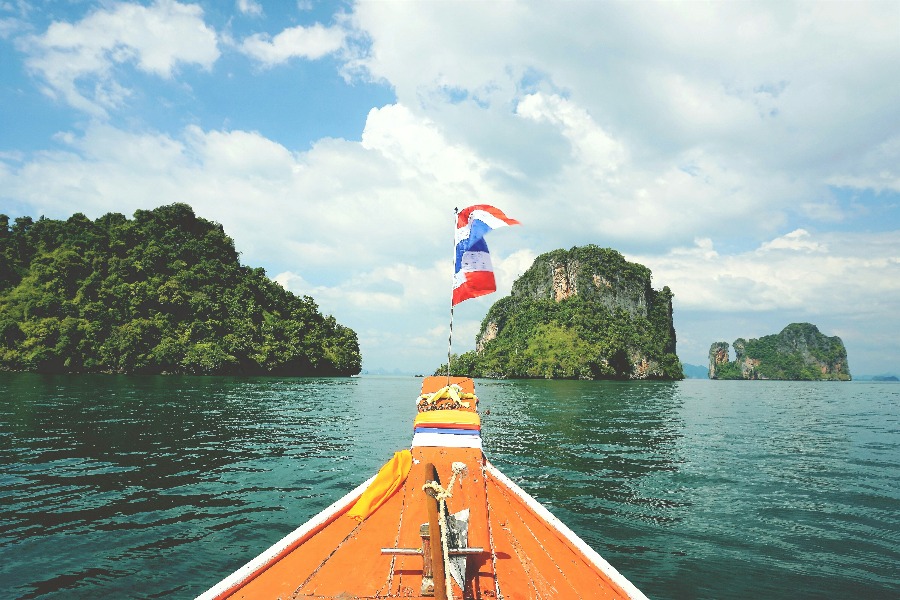
The rest of the archipelago has no runway. Koh Yao Noi, the Phi Phi islands, Koh Lanta and Phang Nga bay are reached by boat, by helicopter or by seaplane. IBC Aviation is the official partner of Siam Seaplane, the country's first amphibious seaplane operator, certified by the CAAT in October 2024. Its Cessna Grand Caravan EX lands on the water as close to the island as possible, up to eight passengers, daylight only.
The first approved landing sites are precisely here, around Phuket and Krabi. The network then grows as further approvals are granted, site by site.
Season matters as much as aircraft. The south-west monsoon soaks the Andaman coast from May to October, exactly when the Gulf of Thailand stays dry. The same trip therefore changes coast depending on the month, and it is the first question our teams ask.
The Gulf of Thailand: Samui and its 2,100 metres
Koh Samui is reached through an airport unlike the others. Built by Bangkok Airways and opened in 1989, it has a single runway of 2,100 m by 45, at 19.5 m elevation, open from 06h00 to 22h00 local time according to the Thai AIP. That length decides the category. A light jet or a midsize operates there without reservation.
Above that, actual takeoff weight becomes the limiting factor, and our Bangkok teams confirm it aircraft by aircraft before every quote. The Bangkok to Koh Samui sector takes about an hour.
Koh Phangan and Koh Tao, its neighbours, have no runway. You arrive through Samui, then continue by boat or helicopter. Further north, Hua Hin has its own 2,100 m runway, with a widening from 35 to 45 m announced, two and a half hours by road from Bangkok.
The north and the east: Chiang Mai, Chiang Rai, Koh Kood
Chiang Mai is about an hour's flying from Bangkok and takes every category. The city holds the great addresses of the north and peaks in November, during the lantern festival. Chiang Rai, further north still, is the only airport in the Golden Triangle.
To the east, Koh Chang and Koh Kood are reached through Trat. The runway there measures 1,800 m by 45, concrete and asphalt, open from 06h00 to 22h00 local time. That length does not close the door to light jets, contrary to what is sometimes written: the real constraint is the airport's status as private property of Bangkok Airways, which in practice requires the operator's prior agreement. Sukhothai, another private airport in the same group, has the same particularity with a 2,100 m runway, a few kilometres from the UNESCO archaeological site.
What changes on 15 September 2026
Thailand's entry regime tightens within days, and the point is worth knowing before planning a stay. The 60-day visa exemption ends on 15 September 2026. It is replaced by a two-tier arrangement, published in the Thai Royal Gazette on 31 August 2026: 30 days for 60 countries and territories, among them the United States, the United Kingdom, Australia, Canada, Japan, France and Germany, and 15 days for Seychelles and Mauritius. The detail is on the official announcement from the Tourism Authority of Thailand and on the site of the Department of Consular Affairs.
A separate formality is often forgotten: the digital arrival card, TDAC, mandatory since 1 May 2025 for every entry into the country whatever the visa regime, and to be filed within the 72 hours before arrival. It is requested on the official immigration portal, and it applies to each entry, including when a regional itinerary takes your passengers out of the country and back in. Our teams check this for every passenger at the time of booking.
From Asia, the Gulf and Europe: which aircraft
The choice splits across the two stages. The long sector to or from Bangkok calls for a heavy jet or an ultra long range aircraft depending on the origin; the domestic leg almost always sits comfortably on a light jet or a midsize, and sometimes on a turboprop when the runway requires it.
| From | To Bangkok | Category |
| Singapore | about 2h20 | light or midsize |
| Hong Kong | about 2h40 | light or midsize |
| Dubai | about 6h30 | heavy jet |
| Geneva or Paris | about 11h00 | ultra long range |
These times are indicative and remain to be confirmed depending on the aircraft, the load and the winds. For reference, our rates start at EUR 4,000 per hour on a light jet and EUR 6,500 on a heavy jet, aircraft, crew, fuel and ground handling included. The detail by category is in our pricing guide.
Arranging your Thailand trip with IBC Aviation
IBC Aviation is an independent broker: we operate no aircraft, we select the one that fits your itinerary among certified operators, and we arrange the whole journey. In Thailand that means three concrete things: confirming that the arrival runway accepts the aircraft at its real weight. Obtaining clearances where the airport is privately owned. Connecting the seaplane or boat leg where the island has no runway.
Our Bangkok office works these platforms daily, and our partnership with Siam Seaplane carries the flight through to the shore. For a trip starting from the capital, our private jet charter in Bangkok page and our Don Mueang airport file set out the departure point.
Private jet charter with IBC Aviation:
Our teams advise you on the private jet best suited to your itinerary and requirements, and organise your trip to or from your destination. Available 24/7:
- France: +33 1 41 69 88 88
- Switzerland: +41 22 880 28 88
- Dubai: +971 55 303 5161
- Bangkok: +66 92 372 4680
- Email: contact@ibc-aviation.com
Frequently asked questions
Which airport should I choose for a private jet in Thailand?
It depends on the arrival runway. U-Tapao, Phuket and Krabi take every category, with 3,000 m or more. Koh Samui, Hua Hin and Sukhothai stop at 2,100 m, which suits a light jet and a midsize. Trat, at 1,800 m, remains open to light jets.
Can a private jet land at Koh Samui?
Yes, on a runway of 2,100 m by 45, open from 06h00 to 22h00 local time. A light jet or a midsize operates there without reservation, and above those categories actual takeoff weight becomes the decisive factor.
How long is a Bangkok to Phuket flight by private jet?
About 1h20, to be confirmed depending on the aircraft and the winds. Koh Samui takes about an hour, Chiang Mai the same. Departure is from the business aviation terminals in Bangkok, with no commercial terminal to pass through, which brings boarding down to a few minutes.
Do I need a visa for Thailand?
The regime changes on 15 September 2026. The 60-day exemption ends. It gives way to 30 days for 60 countries and territories, including the United States, the United Kingdom and France, and to 15 days for Seychelles and Mauritius. The TDAC digital arrival card remains mandatory for every entry, filed within the 72 hours before arrival.
How do I reach an island with no runway?
By boat, by helicopter or by seaplane. IBC Aviation is the official partner of Siam Seaplane, whose amphibious Cessna Grand Caravan EX lands on the water as close to the island as possible, up to eight passengers and in daylight only, the approved sites being first in the Andaman Sea around Phuket and Krabi.
When is the best season for Thailand?
It differs by coast. The south-west monsoon soaks the Andaman side, Phuket and Krabi, from May to October, the period during which the Gulf of Thailand and Koh Samui stay dry. The destination is therefore chosen with the calendar as much as with the map, and our teams raise it first.