





 +41 22 880 28 88
 +33 1 41 69 88 88 (Paris)
 +352 26 20 25 53 88
 +971 55 303 5161
 +66 92 372 4680

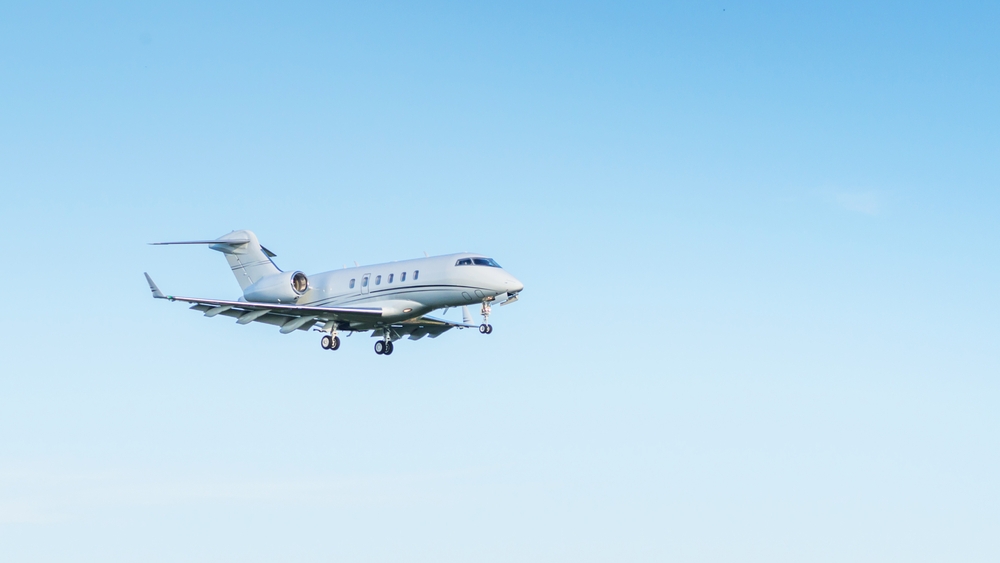
Super Midsize Jets: Models, Range and Charter Prices
Super midsize jets at a glance
Four aircraft come up most often in our charters, but the category is wider : it also covers the Citation X, the Hawker 4000, the Challenger 300 and the Legacy 500, which we charter through our operator network. As an independent broker we are not limited to an in-house fleet.
| Aircraft | Seats | Range | Cabin height | Hold |
| Challenger 350 | 9 | 5,900 km | 1.85 m | 3.00 m3 |
| Citation Latitude | 8 | 5,270 km | 1.83 m | 2.55 m3 |
| Citation Sovereign | 8 | 4,890 km | 1.73 m | 2.83 m3 |
| Legacy 450 | 7 to 10 | 4,700 km | 1.82 m | 4.23 m3 |
Cabin width, not cabin height
This is the point catalogues leave out. Between a midsize and a super midsize, cabin height barely differs at all. What genuinely changes is width, roughly 1.96 m on a midsize against 2.11 to 2.19 m here, along with cabin length.
In practice, a wider cabin allows a real central aisle between two facing rows. You move around standing without stepping over your neighbours' legs, which counts on a five-hour flight with eight people on board.
Height stays between 1.73 and 1.85 m depending on the model. You can stand, but only just if you are tall.
The trade-off nobody mentions: runway length
A super midsize gains range and cabin, but it loses airfield access. Its take-off distance exceeds a midsize by roughly 150 to 380 metres depending on the models compared.
That difference closes some short or high-elevation runways a midsize can still use at maximum weight. It is a real trade-off, not a detail: at a mountain aerodrome or an island with a limited runway, moving up a category can take you further from your destination rather than closer.
It is the first thing our teams check in this bracket, ahead of availability.
A category that exists in no regulation
The term is a commercial convention. Neither ICAO, the FAA nor EASA define super midsize. No authority publishes a range or width threshold that would move an aircraft from one category to the next.
The consequence is visible on our own site: depending on the language, the Citation Sovereign and the Legacy 450 appear as midsize or as super midsize. That is not an error, it reflects the absence of any standard. Compare aircraft on their figures, range, width, hold and take-off distance, never on the category label.
The Citation X, the fastest civil aircraft ever built
One aircraft in this category holds a record few passengers know about: the Citation X and its X+ version were for years the fastest civil aircraft in the sky, with a maximum speed of Mach 0.935, around 1,150 km/h. They only lost that title in December 2025, when the Global 8000 arrived at Mach 0.95.
That is not a brochure figure. It comes from a 37 degree wing sweep, the most pronounced in all of business aviation, and Rolls-Royce AE 3007 engines. The aircraft climbs to 51,000 feet, above commercial traffic and most weather systems, for a range of roughly 6,020 km (3,740 miles).
Cessna ended production in 2018, after 339 aircraft built since 1996, including 29 X+. The fleet is therefore no longer renewed. On a sector where every half hour counts, a Citation X nonetheless remains by far the fastest aircraft in its category.
Bombardier has dominated the category for twenty years
Delivery figures tell a clear story. In February 2025 Bombardier delivered its thousandth super midsize aircraft, a Challenger 3500. The Challenger 300 and then 350 family alone accounts for nearly 800 aircraft since 2004, and the Challenger 350 was the world's most delivered super midsize for six consecutive years.
The Challenger 3500, the latest evolution of the line, passed 200 deliveries in July 2026, less than four years after entering service.
That dominance has a direct consequence for you: it is the sub-family most present on the European charter market, and therefore the easiest to find at short notice. On a forty-eight hour request, a Challenger statistically comes up more often than its rivals.
Legacy or Praetor: a distinction worth money
Embraer announced the Praetor 500 and 600 on 14 October 2018, modernised versions of the Legacy 450 and 500. The Praetor 600 is a super midsize, the Praetor 500 stays in the midsize bracket.
One technical detail is worth knowing before comparing two quotes: a Legacy 450 can be converted to Praetor 500 standard, but a Legacy 500 cannot become a Praetor 600. The systems changes run too deep. In other words, the difference between a Legacy 500 and a Praetor 600 is permanent, not a matter of upgrading.
The Praetor 600 quotes around 7,200 km of range against 6,020 km for the Praetor 500, with Honeywell HTF7500E engines. In 2020 Embraer narrowed its entire business jet line to four models: Phenom 100, Phenom 300, Praetor 500 and Praetor 600.
What a super midsize actually does in a week
The category is understood through its missions rather than its numbers. Three uses come up constantly in our charters.
The European roadshow. A board covering Paris, Milan, Frankfurt and London in three days. A super midsize allows two legs in a day without refuelling in between, with a working area where the meeting continues in the air. This is where cabin width pays for itself: eight people seated facing each other genuinely work, which is impossible in a light jet.
The family transfer to the Mediterranean. Geneva or Paris to or from the Cyclades, Sardinia or the Balearics in peak season, with holiday baggage and sometimes a pet. A hold of 2.55 to 4.23 m3 depending on the model absorbs what the category below turns away.
The Levant sector. London to or from Tel Aviv, roughly 3,600 km, is flown without a stop on a Challenger 350. It is the mission that typically justifies moving up from midsize: the smaller category cannot do it in one leg, this one can.
The airports the category opens, and those it closes
The gain in range opens the whole Mediterranean basin, the Black Sea, the Gulf as far as Dubai at the outer limit, and North Africa without a stop from Western Europe.
The counterpart is concrete. Two examples our clients know well: La Môle-Saint-Tropez, whose short runway accepts light aircraft only, stays out of reach for a super midsize. A flight to Saint-Tropez therefore lands at Nice or Cannes-Mandelieu, with the road transfer that implies in August.
The second case is Samedan, the airport serving St Moritz. At over 1,700 metres of elevation it is the highest airfield in Europe, and thin air mechanically lengthens take-off distance. A super midsize at maximum weight becomes marginal there, while a midsize still gets away. In winter the call is made case by case, on payload and temperature.
That is why we never start from the desired category, but from the destination airfield.
Five hours on board, what really changes
Between a light jet and a super midsize, the difference is not speed but what you can do with the flight time.
Having a flight attendant transforms the meal: table service, hot catering, dietary requirements accommodated. On a five-hour flight departing at midday, that is not a trivial point. The cabin divides into genuinely separate zones, letting part of the group work while the rest sleeps.
Cabin height, at 1.73 to 1.85 m, allows movement standing. Combined with the width, it creates a central aisle the categories below do not have. On a long family sector, that is what separates a bearable flight from a comfortable one.
Super midsize jet price: from 5,500 euros per hour
Rates start at around 5,500 euros per hour, including aircraft, crew, fuel, ground handling and navigation charges. De-icing, special catering and out-of-hours airport opening are added.
Between a midsize at 4,800 euros and a heavy jet at 6,500 euros, the super midsize sits in a tight price band. On a five-hour sector the gap against a midsize is justified by cabin width and range. On three hours, far less so. Our private jet rental rates give the full breakdown by category.
When to choose a midsize, when to move to heavy
Stay with a midsize if your flight runs under four hours, if you are six or fewer, or if your destination imposes a short runway. You save money and lose nothing useful.
Move to a heavy jet as soon as the sector exceeds six hours or you are aiming for New York, Dubai or Jeddah without a stop. Our article on heavy jet or ultra long range covers the rest of the range, and our guide on range by aircraft category sets out the distance thresholds.
Chartering a super midsize with IBC Aviation
As an independent broker we compare availability across several operators against your request, and verify the runway length available at destination before confirming the aircraft. In this category that check is what prevents a last-minute diversion. Every model is listed on our super midsize jets page.
Private jet charter with IBC Aviation:
Our teams advise you on the private jet best suited to your itinerary and requirements, and organise your trip to or from your destination. Available 24/7:
- France: +33 1 41 69 88 88
- Switzerland: +41 22 880 28 88
- Dubai: +971 55 303 5161
- Bangkok: +66 92 372 4680
- Email: contact@ibc-aviation.com
Frequently asked questions
How much does a super midsize jet cost per hour?
From around 5,500 euros per flying hour, including aircraft, crew, fuel, ground handling and charges. De-icing and special catering are added. The category sits between the midsize at 4,800 euros and the heavy jet at 6,500 euros.
What is the difference from a midsize jet?
Cabin width, roughly 2.11 to 2.19 m against 1.96 m, and range. Cabin height barely separates them. In exchange, a super midsize needs 150 to 380 metres more runway.
Is there a flight attendant on a super midsize?
Yes, the category carries cabin crew, unlike light jets. A flight attendant serves throughout the flight, which changes the nature of the trip on sectors of five to six hours.
Is super midsize an official category?
No. Neither ICAO, the FAA nor EASA define it. It is an industry convention, which is why the same aircraft is listed as midsize by one broker and super midsize by another. Compare the figures, not the labels.