




 +41 22 880 28 88
 +33 1 41 69 88 88 (Paris)
 +352 26 20 25 53 88
 +971 55 303 5161
 +66 92 372 4680

Which Private Jet Category for Which Itinerary
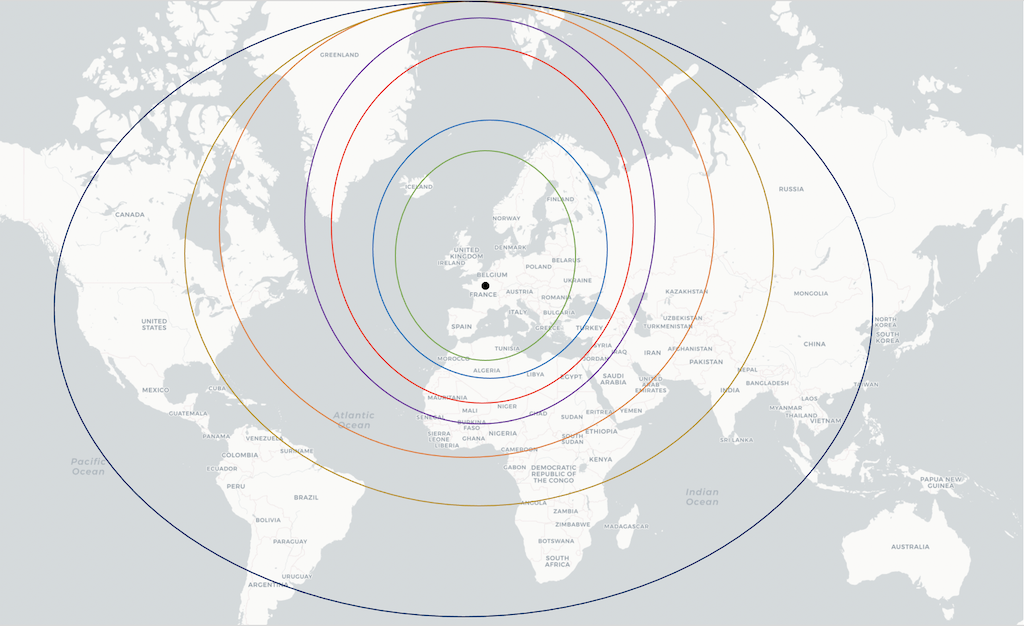
Which category for which distance: the decision table
This table sets out the thresholds our teams apply daily. Prices are starting hourly rates, all inclusive apart from de-icing and special catering.
| Flight duration | Category | Passengers | Hourly rate | Typical sector |
| Under 2h | Very light jet | 4 to 5 | from 3,500 euros | Paris to or from Lyon |
| 2h to 4h30 | Light jet | 6 to 8 | from 4,000 euros | Paris to or from Athens |
| 3h to 4h30 | Midsize | 8 to 9 | from 4,800 euros | Geneva to or from Marrakesh |
| 4h30 to 6h | Super midsize | 8 to 10 | from 5,500 euros | London to or from Tel Aviv |
| 6h to 9h | Heavy jet | 8 to 16 | from 6,500 euros | Paris to or from New York |
| Over 9h | Ultra long range | 12 to 16 | 9,000 to 12,000 euros | Geneva to or from Singapore |
Why distance outranks passenger count
This is the most common mistake. Four people flying Paris to or from New York need a heavy jet, not a very light jet, even though the seat count would do. Eight people flying Paris to or from Lyon have no reason to pay for a long range aircraft.
The reason is mechanical: an aircraft's range is not negotiable, whereas cabin configuration is. An eight-seat light jet will never cross the Atlantic, whatever the passenger count on board.
A second point, less well known: manufacturer range assumes a reduced passenger count, minimum reserves and favourable winds. Every additional passenger and every bag cuts the real figure. In winter, westerly winds over the North Atlantic can remove several hundred kilometres from the distance actually achievable.
The airport, the criterion that rules out entire categories
The second factor consistently comes last in catalogues, when it should come straight after distance. Some destinations impose a short runway, a particular approach or high elevation, and those constraints eliminate whole categories.
Three concrete examples. La Môle-Saint-Tropez accepts light aircraft only: a super midsize is refused and has to land at Nice. Samedan, the airport serving St Moritz at over 1,700 metres of elevation, lengthens take-off distance to the point where a super midsize at maximum weight becomes marginal while a midsize still gets away. Courchevel altiport, with its 537 metre runway and 18 % gradient, accepts no business jet at all, whatever the category.
That is why our teams always start from the destination airfield, never from the desired category.
The precise switch points
Here are the thresholds we apply, with the signal that triggers each one.
- Very light to light: flight over 2 hours, more than 4 passengers, or baggage the 1.6 m3 hold turns away.
- Light to midsize: flight over 4h30, or the need to stand up in the cabin.
- Midsize to super midsize: flight over 4 hours with 8 passengers, or the need for cabin service by a flight attendant.
- Super midsize to heavy: crossing the North Atlantic or reaching the Gulf without a stop.
- Heavy to ultra long range: flight over 9 hours, typically Southeast Asia or the US west coast.
One nuance that matters: none of these categories exists in regulation. Neither ICAO, the FAA nor EASA define them. They are commercial conventions, which is why the same aircraft is listed as midsize by one broker and super midsize by another. Compare the figures, never the labels.
What each category delivers in the cabin
Comfort follows a clear progression, structured by two thresholds.
The first is standing height. In very light and light jets, cabin height tops out between 1.37 and 1.55 m: you do not stand up. From midsize upwards it exceeds 1.70 m.
The second is the presence of a flight attendant. The very light and light categories carry no cabin crew. Table service, hot catering and dietary requirements start at super midsize. Above that, in heavy and ultra long range, the cabin divides into three or four distinct zones, with genuine beds in night configuration.
Two aircraft that escape the categories
Two models are worth knowing because they deliberately blur the lines.
The Pilatus PC-24 is the only business jet certified for unpaved runways, grass, gravel and snow. Its manufacturer quotes access to almost twice as many airports as other jets on the market. For a remote destination, it changes the picture far more than an extra category step.
The Phenom 300, classed as a light jet, holds a range close to some midsize aircraft at a lower hourly cost. It has been the most delivered light jet in the world for fourteen consecutive years, with over 900 aircraft in service across 70 countries, which also makes it the easiest to find at short notice.
The real budget, beyond the hourly rate
The hourly rate does not tell the whole story. Three items are systematically added and often surprise: aircraft positioning, when it has to be flown in empty from another base, de-icing in winter, and wi-fi, almost always billed as a supplement.
On a short flight, positioning can cost as much as the sector itself. It is the primary saving lever, and it is where a broker's work shows: finding the aircraft already in place rather than the best aircraft on paper. Rate details are in our private jet charter prices, and empty leg flights exploit exactly that repositioning logic.
Chartering with IBC Aviation
As an independent broker we are not tied to a fleet. We compare the real availability of several operators against your request, verify range on your precise sector and the aircraft's compatibility with the intended airport, then propose the category that fits, not the one that pays best. Every aircraft is listed on our fleet page.
Private jet charter with IBC Aviation:
Our teams advise you on the private jet best suited to your itinerary and requirements, and organise your trip to or from your destination. Available 24/7:
- France: +33 1 41 69 88 88
- Switzerland: +41 22 880 28 88
- Dubai: +971 55 303 5161
- Bangkok: +66 92 372 4680
- Email: contact@ibc-aviation.com
Frequently asked questions
Which private jet category for a 2 hour flight?
A very light jet is enough up to two hours with four passengers, from 3,500 euros per hour. Beyond two hours or four passengers, the light jet becomes more suitable, from 4,000 euros per hour.
Should the choice follow distance or passenger count?
Distance first, then the destination airport, and only then the number of passengers. An aircraft's range is not negotiable, whereas cabin configuration adapts.
Which category crosses the Atlantic without a stop?
The heavy jet, from 6,500 euros per hour. It flies Paris to or from New York in one leg. Ultra long range only becomes necessary beyond nine hours of flying, towards Southeast Asia or the US west coast.
Are these categories official?
No. Neither ICAO, the FAA nor EASA define them. They are industry conventions, which is why the same aircraft changes category depending on the broker consulted. Compare range, cabin and hold, not labels.