





 +41 22 880 28 88
 +33 1 41 69 88 88 (Paris)
 +352 26 20 25 53 88
 +971 55 303 5161
 +66 92 372 4680


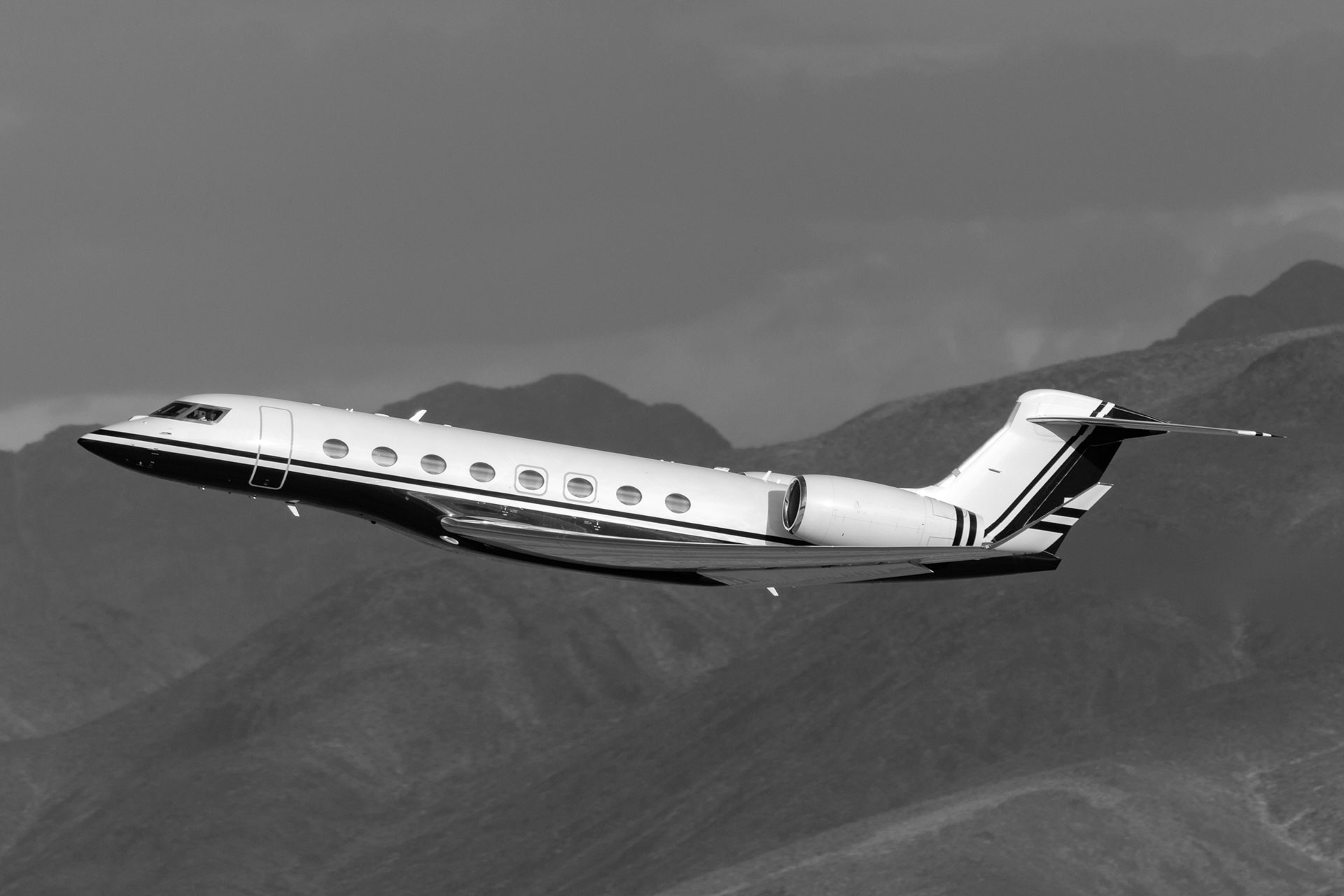
Which Private Jets Can Cross the Atlantic Non-Stop?
Six private jets to compare for a non-stop Atlantic crossing
The Falcon 7X and 8X, Global 6000 and 7500, Gulfstream G650ER and G700 can enter the assessment for non-stop flights between Europe and the Americas. Their theoretical ranges run from approximately 11,020 to 14,353 km, but actual capability depends on routing, winds, passengers, luggage and airports. For travel to or from Europe, IBC Aviation’s Paris office asks the operator to assess each direction. To compare aircraft for your Atlantic crossing, send your cities and dates.
New York-Paris, a US West Coast sector and a Caribbean trip are different missions. Our Paris team compares models against your journey, cabin requirements and payload.
What does this aircraft category cost
These aircraft sit in our ultra-long-range category, with an hourly reference of €9,000 to €12,000. The Global 6000 also belongs to the ultra-long-range category. A quotation covers the whole aircraft and your schedule, including positioning, sectors, crew arrangements and any stay.
When comparing proposals, establish whether a technical stop is included and how the return will operate. A lower hourly rate alone will not explain the complete mission. Our charter rates by aircraft category help set a reference budget; they do not provide one fixed price for every Atlantic crossing.
What the manufacturers’ 11,020 to 14,353 km figures mean
| Aircraft | Theoretical range | Reference speed | Reference load |
| Falcon 7X | 11,020 km | Mach 0.80 | 8 passengers, 3 crew |
| Falcon 8X | 11,945 km | Mach 0.80 | 8 passengers, 3 crew |
| Global 6000 | 11,112 km | Mach 0.85 | 8 passengers, 4 crew |
| Gulfstream G650ER | 13,890 km | Mach 0.85 | 8 passengers, 4 crew |
| Global 7500 | 14,260 km | Mach 0.85 | 8 passengers, 4 crew |
| Gulfstream G700 | 14,353 km | Mach 0.85 | 8 passengers, 4 crew |
These references include NBAA IFR reserves used to present aircraft performance. The two Global specifications assume ISA standard atmospheric conditions; the Falcon 8X technical reference used here also specifies zero wind and sea level. None describes the weather on your departure date. The kilometre equivalents retain the manufacturers’ rounding.
Speed makes a difference too. The G700 quotes 14,353 km at Mach 0.85 but 12,316 km at Mach 0.90, with the same eight passengers and four crew assumed. Asking to fly faster can therefore change the margin available for a non-stop mission.
Eight reference passengers are different from nineteen seats with full fuel
Maximum seating and payload available with full fuel are separate measurements. The G650ER’s theoretical specification lists maximum payload at 2,948 kg, compared with 816 kg with full fuel. For the G700, the figures are 2,715 kg and 832 kg respectively. Outfitting and optional equipment affect actual weights.
You cannot combine maximum cabin occupancy with the range quoted for eight passengers. A larger delegation, heavy suitcases or professional equipment changes the assessment. Give us the dimensions of the luggage travelling on your private jet, particularly where cases or equipment need to fit through a hold door.
The proposed aircraft’s operator uses its actual weights and consumption figures, as two aircraft sharing a model name can have different outfitting. A heavier layout can reduce the fuel margin available for your journey.
Which model should you consider for your party
- Falcon 7X: a candidate for Atlantic routes within its assessed capabilities. Its cabin is 1.88 m high and 2.34 m wide. The offered layout helps distinguish the individual aircraft available for your dates.
- Falcon 8X: it has the same cabin width and height as the 7X, with additional length and greater theoretical range. Our Falcon 7X and 8X comparison explains those differences.
- Global 6000: its cabin measures 1.88 m high and 2.41 m wide, with manufacturer capacity up to 17 passengers. That maximum does not establish the payload possible on a particular Atlantic sector.
- Gulfstream G650ER: finished cabin height is 1.91 m and width is 2.49 m, with layouts accommodating up to 19 passengers. The ER must be distinguished from the G650. Our article on the G650 and G650ER covers both variants.
- Global 7500: its 1.88 m by 2.44 m cabin is presented with four areas in the manufacturer’s standard architecture. Seating, separation and sleeping arrangements still need confirmation on the offered aircraft.
- Gulfstream G700: finished cabin height and width are 1.91 m and 2.49 m. In service since April 2024, it is among the models that can be considered, subject to charter availability for your itinerary.
Arrange your crossing with our Paris office
Tell us what needs to happen on board: sleeping, a team meeting, individual work or family travel. The Paris office matches those requirements to aircraft actually offered for the mission. We review the cabin plan, usable seating and operating conditions with the operator before presenting the options.
Both airports and the return sector matter. To request a quotation for your group’s crossing, include passenger numbers in each direction, luggage and preferred timings. If someone returns earlier or from another city, that may affect the aircraft and crew programme.
Our guide to aircraft categories for different itineraries provides context for the shortlist. The final assessment, however, concerns one specific mission and one proposed aircraft, rather than a category name alone.
Confirm sleeping space, cabin layout and connectivity
A cabin advertised with many seats does not necessarily provide the same number of sleeping positions. Ask for the night layout, convertible seats and partitions. A bedroom, shower or double bed should never be assumed from the model name.
Published lengths also need careful reading. The Global 6000 lists 13.18 m from the cockpit divider to the rear cabin, excluding the baggage compartment; the Global 7500 uses a comparable definition for 16.59 m. Gulfstream quotes cabin length excluding baggage at 14.27 m for the G650ER and 17.35 m for the G700. The floor plan shows which areas you can actually use.
For an airborne meeting, specify equipment and connectivity requirements. Our private jet Wi-Fi guide separates installed equipment from the service available during the flight. A cabin photograph is not enough to establish either.
Why the two directions have different margins
Over the North Atlantic, jet streams generally flow from west to east, changing in position and strength. A westbound sector can require more time and fuel than an eastbound flight. A model having flown a route in one direction does not confirm the opposite direction with your passengers and luggage.
Using the day’s forecast and planned routing, the operator assesses each sector separately and establishes a time for the actual flight. There is no single fixed time penalty to add to every return flight, and the most direct line on a map need not be the route flown.
When a technical stop enters the plan
Brochure range does not replace fuel planning. Within the European commercial air transport framework, EASA’s planning requirements include weights, weather, consumption, runways, routing and anticipated delays. Trip fuel, contingency, destination alternate fuel and final reserves serve different purposes.
If the assessed conditions do not permit a non-stop mission, a technical stop can be considered. The proposal should then separate flight time, the ground stop and expected arrival. Choosing another aircraft or accepting a stop depends on the complete schedule you need to protect.
A useful comparison states what happens if the expected wind, payload or departure airport changes. It should also establish who will confirm those details as the flight approaches. That makes it possible to judge the proposals on the trip you are planning, rather than on brochure figures alone.
Mathis Le Cadre prepares this comparison from Paris. You can request a proposal for both Atlantic sectors and specify your priorities: arrival time, rest on board or a non-stop flight subject to operational feasibility.
Your contact for your flights
Mathis Le Cadre
Paris office
Mathis handles your request from quote to return: one contact for your whole trip. Our teams remain available 24/7.
Our offices · France +33 1 41 69 88 88 · Switzerland +41 22 880 28 88 · Luxembourg +352 26 20 25 53 88 · Dubai +971 55 303 5161 · Bangkok +66 92 372 4680 · contact@ibc-aviation.com
Frequently asked questions
Which private jets can cross the Atlantic without a stop?
The Falcon 7X and 8X, Global 6000 and 7500, G650ER and G700 can be assessed for non-stop Atlantic routes. Feasibility depends on the route, direction, winds, load and airports. The actual flight still requires an operational assessment.
How much does an Atlantic private jet charter cost?
The ultra-long-range category has an hourly reference of €9,000 to €12,000. The whole-aircraft quotation depends on positioning, outbound and return schedules, crew and any technical stops. There is no single price for every crossing.
Does manufacturer range guarantee a non-stop flight?
No. The figures cited assume reference conditions with eight passengers, a defined speed and NBAA IFR reserves. Actual weights, winds, routing and airport constraints can change operational feasibility.
Can passengers sleep in every seat?
Seat count does not establish sleeping capacity. The proposed aircraft’s night layout and equipment must be confirmed. A bedroom, shower or double bed is not a guaranteed standard feature on every aircraft of a given model.
How long does a transatlantic private jet flight take?
Flight time is calculated for each route using the airports, aircraft and direction of travel. Generally west-to-east winds over the North Atlantic can change that time. Any technical stop adds to the trip; outbound and return sectors are assessed separately.